Homeownership: The Heart of the American Dream

Everyone’s vision for the future is personal and unique. But for many, common goals include success, freedom, and prosperity — values closely tied to having your own home and the iconic feeling of achieving the American Dream.

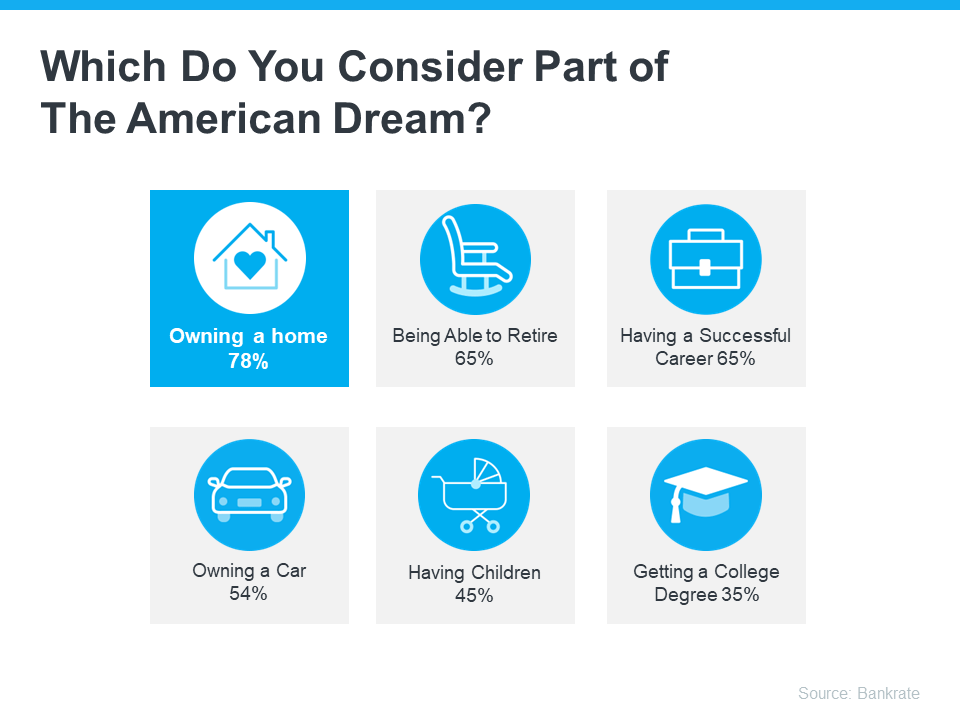
A recent survey by Bankrate reveals exactly that: homeownership is still a part of the American Dream. The results show, at 78%, that owning a home tops the list, surpassing other significant milestones such as retirement, having a successful career, and more (see below):No Caption Received

So, why is buying a home important to so many today? One reason is the financial and physical security it provides. Many people see homeownership as a way to reduce stress because owning a home with a fixed-rate mortgage stabilizes what is likely their largest monthly expense.

Another factor is the potential for building wealth. That’s because, over time, homeowners gain equity as they pay down their mortgage and as home prices appreciate, leading to longer-term financial stability.

But what about the responsibilities that come with owning and maintaining a home? According to a survey by Entrata, only 23% of renters feel homeownership is too much work, indicating the majority are open to the commitments and obligations that come with being a homeowner.

What Does This Mean for You?

While buying a home today might seem daunting due to higher mortgage rates and rising home prices, the long-term benefits can make it worthwhile. If you’re considering homeownership, remember that it’s more than just a financial investment — it’s a step toward securing your future.

Bottom Line

Owning a home is a significant and powerful decision that represents a big part of the American Dream. If you’re ready to take this step, let’s connect so you have someone who can guide you through the process and help you make your homeownership goals a reality.

Housing Market Forecast: What’s Ahead for the 2nd Half of 2024

As we move into the second half of 2024, here’s what experts say you should expect for home prices, mortgage rates, and home sales.

Home Prices Are Expected To Climb Moderately

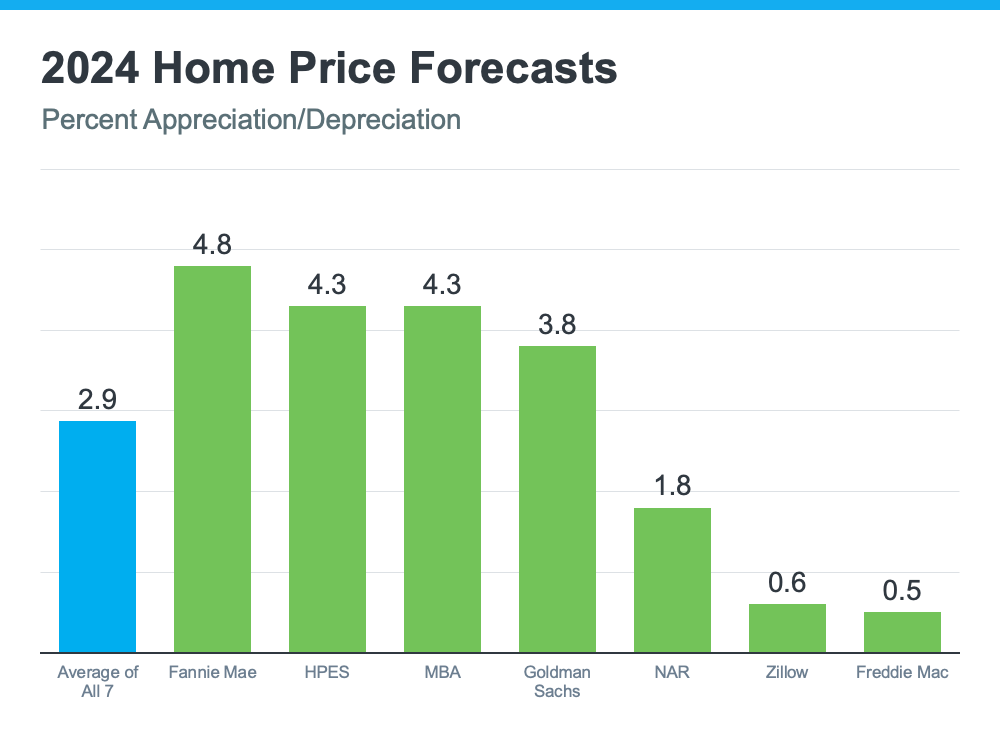
Home prices are forecasted to rise at a more normal pace. The graph below shows the latest forecasts from seven of the most trusted sources in the industry:

No Caption Received

The reason for continued appreciation? The supply of homes for sale. Jessica Lautz, Deputy Chief Economist at the National Association of Realtors (NAR), explains:

“One thing that seems to be pretty solid is that home prices are going to continue to go up, and the reason is that we don’t have housing inventory.”

While inventory is up compared to the last couple of years, it’s still low overall. And because there still aren’t enough homes to go around, that’ll keep upward pressure on prices.

If you’re thinking of buying, the good news is you won’t have to deal with prices skyrocketing like they did during the pandemic. Just remember, prices aren’t expected to drop. They’ll continue climbing, just at a slower pace.

So, getting into the market sooner rather than later could still save you money in the long run. Plus, you can feel confident experts say your home will grow in value after you buy it.

Mortgage Rates Are Forecast To Come Down Slightly

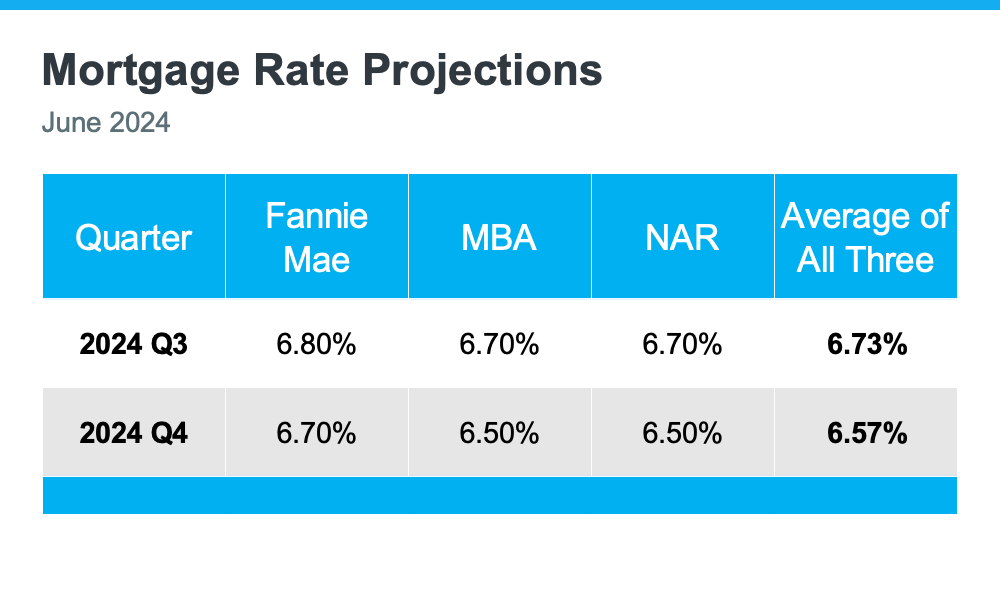
One of the best pieces of news for both buyers and sellers is that mortgage rates are expected to come down a bit, according to Fannie Mae, the Mortgage Bankers Association (MBA), and NAR (see chart below):

No Caption ReceivedWhen you buy, even a small drop in mortgage rates can make a big difference in your monthly payments. For sellers, lower rates will bring more buyers back into the market, which can help you sell faster and potentially at a higher price. Plus, it may help you get off the fence, if you’ve been hesitant to sell due to today’s rates.

Home Sales Are Projected To Hold Steady

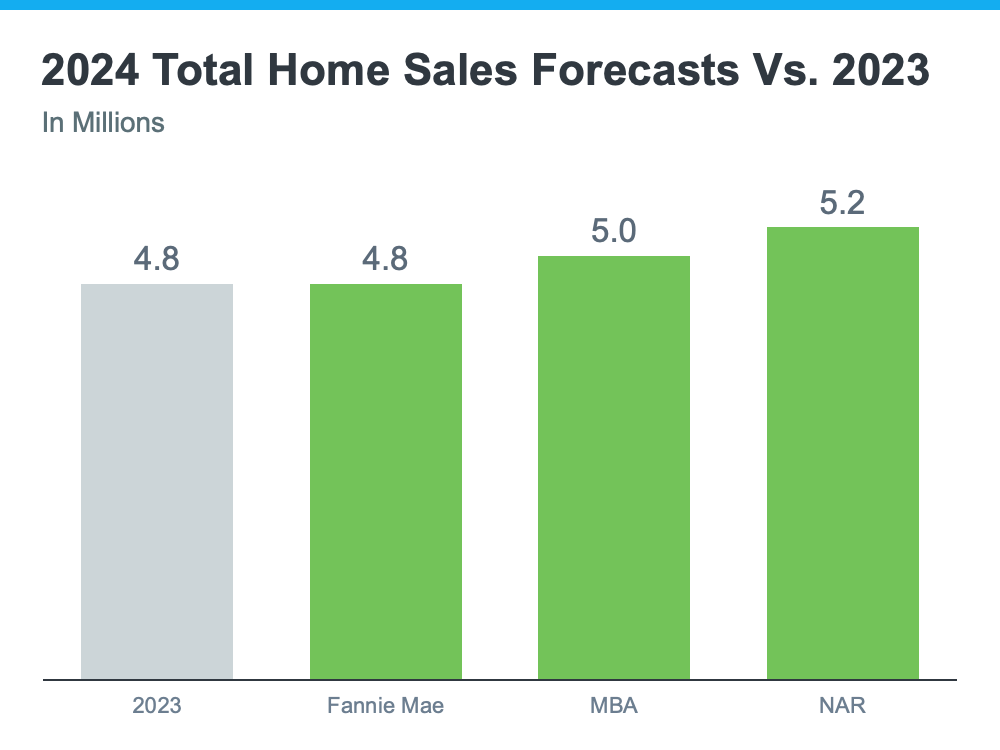
For 2024, the number of home sales will be about the same as last year and may even rise slightly. The graph below compares the 2024 home sales forecasts from Fannie Mae, MBA, and NAR to the 4.8 million homes that sold last year:

No Caption Received

The average of the three forecasts is about 5 million sales in 2024 – a small increase from 2023. Lawrence Yun, Chief Economist at NAR, explains why:

“Job gains, steady mortgage rates and the release of inventory from pent-up home sellers will lead to more sales.”

With more inventory available and mortgage rates expected to go down, a few more homes are expected to be sold this year compared to last year. This means more people will be able to move. Let’s work together to make sure you’re one of them.

Bottom Line

If you have any questions or need help navigating the market, reach out.

Home Prices Aren’t Declining, But Headlines Might Make You Think They Are

If you’ve seen the news lately about home sellers slashing prices, it’s a great example of how headlines do more to terrify than clarify. Here’s what’s really happening with prices.

The bottom line is home prices are higher than they were a year ago at this time, and they’re expected to keep rising, just at a slower pace.

But a recent article from Redfin notes,

“Price Drops Hit Highest Level in 18 Months As High Rates Dampen Buyer Demand.”

And that might make you think prices are declining.

Now, while it’s true the latest report from Realtor.com also shows 16.6% of homes on the market had price reductions in May, which is up from 12.7% last May, that doesn’t mean overall home prices are falling.

The key is knowing the difference between the asking price and the sold price.

Understanding Asking Price vs. Sold Price

In essence, the asking price, also known as a listing price, is the amount a seller hopes to get for their home when they list it. In reality, sellers can’t just put any price tag on their house and expect it to sell for top dollar. Today’s buyers are savvy customers, and when they aren’t willing to pay a premium for a home because their budgets are strained by higher mortgage rates, sellers need to adjust. And that’s what’s happening right now.

Based on market factors and what offers that seller receives, that asking price can change. If a seller isn’t getting much foot traffic, you may see them revise the price and make an adjustment to reignite interest in the home – and sometimes that’s because they’ve overpriced it from the start. That’s where price reductions come in, and when you see “price drops” in a headline, it sounds like declining home prices.

Mike Simonsen, CEO and Founder of Altos Research, says:

“Not only is the share of homes with price cuts elevated compared to one year ago, but more price cuts are happening each week than last year.”

On the other hand, the final sold price is the amount a buyer actually pays when the transaction is complete.

Here’s the most important thing to note: Actual sold prices are still rising, and they’re expected to continue to do so at least over the next 5 years.

What Does This Mean for Home Prices?

So, while there’s been an increase in price reductions recently, this doesn’t mean overall home values are declining. Instead, it’s a sign that demand is moderating. And, as a result, sellers are adjusting their expectations to align with today’s market reality.

Even with more price reductions, home values are still growing on an annual basis, as they do nearly every year in the housing market. According to the Federal Housing Finance Agency (FHFA), home prices went up 6.6% over the last year (see below):No Caption Received
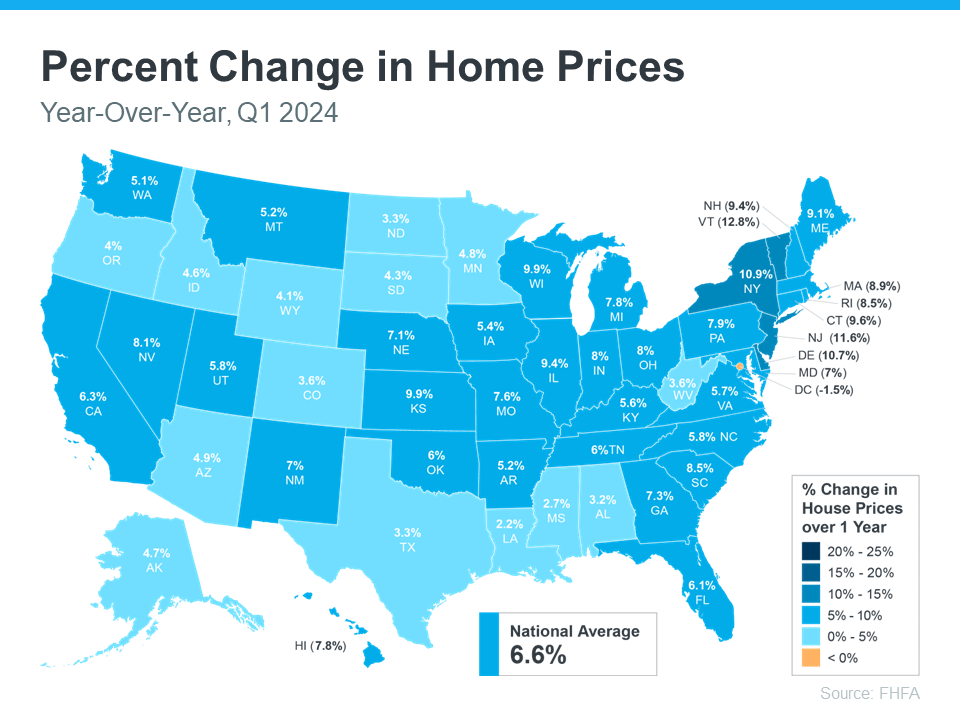
This map shows how prices rose just about everywhere in the country, indicating the market is not in decline.

So, while seller price reductions are often a leading indicator that prices may moderate in the months ahead, which experts have been saying for a while is expected to happen, they aren’t necessarily reason for alarm. The same article from Redfin also states:

“. . .those metrics suggest sale-price growth could soften in the coming months as persistently high mortgage rates turn off homebuyers. For now, the median-home sale price is up 4.3% year over year to another record high. . .”

And with inventory as tight as it is today, price moderation is much more likely in upcoming months than price declines.

Why This Is Good News for Buyers and Sellers

For buyers, more realistic asking prices mean a better chance of securing a home at a fair price. It also means you can enter the market with more confidence, knowing prices are stabilizing rather than continuing to skyrocket.

For sellers, understanding the need to adjust your asking price can lead to faster sales and fewer price negotiations. Setting a realistic price from the start can attract more serious buyers and lead to smoother transactions.

Bottom Line

While the uptick in price reductions might seem troubling, it’s not a cause for concern. It reflects a market adjusting to new conditions. Home prices are continuing to grow, just at a more moderate pace.


April 2024 Market Report

<p>
<span style=”font-size:10pt;”><em><strong>Note: April 2024 data below are the most recent released by the National Association of Realtors.</strong></em></span></p>
<p>
Total existing-home sales (completed transactions that include single-family homes, townhomes, condominiums and co-ops) receded in April, according to the National Association of REALTORS&reg;. All four major U.S. regions posted month-over-month declines. Year-over-year, sales decreased in the Northeast, Midwest and South but increased in the West.</p>
<p>
<a href=”https://www.ihomefinder.com/wp-content/uploads/2024/06/2024-04-existing-home-sales-housing-snapshot-infographic-05-22-2024-1000w-1500h.png” target=”_blank”><img alt=”National Association of Realtors April 2024 Data” src=”https://www.ihomefinder.com/wp-content/uploads/2024/06/2024-04-existing-home-sales-housing-snapshot-infographic-05-22-2024-1000w-1500h.png” style=”width: 350px; height: 541px; float: right; margin-left: 15px; margin-bottom: 5px;” /></a></p>
<div>
<div>
&quot;Home sales changed little overall, but the upper-end market is experiencing a sizable gain due to more supply coming onto the market,&quot; said NAR Chief Economist Lawrence Yun.</div>
</div>
<p>
Total housing inventory at the end of April was 1.21 million units, up 9% from March and 16.3% from one year ago (1.04 million). Unsold inventory sits at a 3.5-month supply at the current sales pace, up from 3.2 months in March and 3.0 months in April 2023. For homes priced $1 million or more, inventory and sales increased by 34% and 40%, respectively, from a year ago.</p>
<div>
The median existing-home price for all housing types in April was $407,600, an increase of 5.7% from the previous year ($385,800). All four U.S. regions registered price gains.</div>
<div>
&nbsp;</div>
<div>
&quot;Home prices reaching a record high for the month of April is very good news for homeowners,&quot; Yun added. &quot;However, the pace of price increases should taper off since more housing inventory is becoming available.</div>
<div>
&nbsp;</div>
<div>
According to the monthly <a href=”https://www.nar.realtor/research-and-statistics/research-reports/realtors-confidence-index” target=”_blank”>REALTORS&reg; Confidence Index</a>, properties typically remained on the market for 26 days in April, down from 33 days in March but up from 22 days in April 2023.</div>
<p>
First-time buyers were responsible for 33% of sales in April, up from 32% in March and 29% in April 2023. NAR's 2023 <a href=”https://www.nar.realtor/research-and-statistics/research-reports/highlights-from-the-profile-of-home-buyers-and-sellers” target=”_blank”>Profile of Home Buyers and Sellers</a> &ndash; released in November 20234 &ndash; found that the annual share of first-time buyers was 32%.</p>
<p>
All-cash sales accounted for 28% of transactions in April, identical to March and one year ago.</p>
<div>
<div>
<div>
Individual investors or second-home buyers, who make up many cash sales, purchased 16% of homes in April, up from 15% in March but down from 17% in April 2023.</div>
</div>
<div>
&nbsp;</div>
</div>
<div>
<div>
According to Freddie Mac, the <a href=”https://www.freddiemac.com/pmms”>30-year fixed-rate mortgage</a> averaged 7.02% as of May 16. That's down from 7.09% the previous week but up from 6.39% one year ago.</div>
<div>
&nbsp;</div>
<div>
&nbsp;</div>
</div>
<div>
<span style=”font-size:14pt;”><strong>Regional Breakdown</strong></span><br />
&nbsp;</div>
<div>
<div>
<div>
<div>
<div>
<div>
Existing-home sales in the Northeast waned 4% from March to an annual rate of 480,000 in April, a decline of 4% from April 2023. The median price in the Northeast was $458,500, up 8.5% from the previous year.</div>
<div>
&nbsp;</div>
<div>
In the Midwest, existing-home sales slipped 1% from one month ago to an annual rate of 1 million in April, down 1% from one year ago. The median price in the Midwest was $303,600, up 6% from April 2023.</div>
<div>
&nbsp;</div>
<div>
Existing-home sales in the South descended 1.6% from March to an annual rate of 1.9 million in April, down 3.1% from the prior year. The median price in the South was $366,200, up 3.7% from last year.</div>
<div>
&nbsp;</div>
<div>
In the West, existing-home sales retracted 2.6% from a month ago to an annual rate of 760,000 in April, an increase of 1.3% from one year before. The median price in the West was $629,600, up 9.3% from April 2023.</div>
</div>
</div>
</div>
</div>
<p>
&nbsp;</p>
</div>

How VA Loans Can Help You Buy a Home

For over 80 years, Veterans Affairs (VA) home loans have helped millions of veterans buy their own homes. If you or someone you know has served in the military, it’s important to learn about this program and its benefits.

Here are some key things to know about VA loans before buying a home.

Top Benefits of VA Home Loans

VA home loans make it easier for veterans to buy a home, and they’re a great perk for those who qualify. According to the Department of Veteran Affairs, some benefits include:

  • Options for No Down Payment: Qualified borrowers can often purchase a home with no down payment. That’s a huge weight lifted when you’re trying to save for a home. The Associated Press says:

“. . . about 90% of VA loans are used to purchase a home with no money down.”

  • Don’t Require Private Mortgage Insurance (PMI): Many other loans with down payments under 20% require PMI. VA loans do not, which means veterans can save on their monthly housing costs.
  • Limited Closing Costs: There are limits on the types of closing costs you pay when you qualify for a VA home loan. So, more money stays in your pocket when it’s time to seal the deal.

An article from Veterans United sums up how remarkable this loan can be:

“For the vast majority of military borrowers, VA loans represent the most powerful lending program on the market. These flexible, $0-down payment mortgages have helped more than 24 million service members become homeowners since 1944.”

Bottom Line

Owning a home is the American Dream. Veterans give a lot to protect our country, and one way to honor them is by making sure they know about VA home loans.

March 2024 Market Update

<p>
<span style=”font-family:arial,helvetica,sans-serif;”><span style=”font-size:10pt;”><em><strong>Note: Data below from March 2024 is the most recent from the National Association of Realtors.</strong></em></span></span></p>
<p>
<span style=”font-size:14pt;”><span style=”font-family:arial,helvetica,sans-serif;”>Existing-home sales&nbsp;slipped in March, according to the National Association of REALTORS&reg;. Among the four major U.S. regions, sales slid in the Midwest, South and West, but rose in the Northeast for the first time since November 2023. Year-over-year, sales decreased in all regions.</span></span></p>
<p>
<span style=”font-size:14pt;”><span style=”font-family:arial,helvetica,sans-serif;”>Total existing home sales&nbsp;&ndash; completed transactions that include single-family homes, townhomes, condominiums and co-ops </span></span><span style=”font-family:arial,helvetica,sans-serif;”>-&nbsp;</span><span style=”font-size:14pt;”><span style=”font-family:arial,helvetica,sans-serif;”>receded 4.3% from February to a seasonally adjusted annual rate of 4.19 million in March. Year-over-year, sales waned 3.7% (down from 4.35 million in March 2023).</span></span><br />
<br />
<span style=”font-size:14pt;”><span style=”font-family:arial,helvetica,sans-serif;”><img alt=”NAR March 2024 Existing Home Sales Report Infographic” src=”https://www.ihomefinder.com/wp-content/uploads/2024/04/2024-03-existing-home-sales-housing-snapshot-infographic-04-18-2024-1000w-1500h.png” style=”float: right; margin: 4px 10px; height: 321px; width: 214px;” />&quot;Though rebounding from cyclical lows, home sales are stuck because interest rates have not made any major moves,&quot; said NAR Chief Economist Lawrence Yun. &quot;There are nearly six million more jobs now compared to pre-COVID highs, which suggests more aspiring home buyers exist in the market.&quot;</span></span></p>
<div>
<span style=”font-size:14pt;”><span style=”font-family:arial,helvetica,sans-serif;”>Total housing inventory registered at the end of&nbsp;March was 1.11 million units, up 4.7% from February and 14.4% from one year ago (970,000). Unsold inventory sits at a 3.2-month supply at the current sales pace, up from 2.9 months in February and 2.7 months in March 2023.</span></span></div>
<div>
&nbsp;</div>
<div>
<span style=”font-size:14pt;”><span style=”font-family:arial,helvetica,sans-serif;”>&quot;More inventory is always welcomed in the current environment,&quot; Yun added. &quot;Frankly, it's a great time to list with ongoing multiple offers on mid-priced properties and, overall, home prices continuing to rise.&quot;</span></span></div>
<div>
&nbsp;</div>
<div>
<span style=”font-size:14pt;”><span style=”font-family:arial,helvetica,sans-serif;”>The median existing-home price for all housing types in&nbsp;March was</span></span> <span style=”font-size:14pt;”><span style=”font-family:arial,helvetica,sans-serif;”>$393,500, an increase of 4.8% from the previous year ($375,300). All four U.S. regions registered price gains.</span></span></div>
<div>
&nbsp;</div>
<div>
<span style=”font-size:14pt;”><span style=”font-family:arial,helvetica,sans-serif;”>According to the REALTORS&reg; Confidence Index, properties typically remained on the market for&nbsp;33 days in March, down from 38 days in February but up from 29 days in March 2023.</span></span></div>
<div>
&nbsp;</div>
<div>
<span style=”font-size:14pt;”><span style=”font-family:arial,helvetica,sans-serif;”>First-time buyers were responsible for</span></span>&nbsp; <span style=”font-size:14pt;”><span style=”font-family:arial,helvetica,sans-serif;”>32% of sales in March, up from 26% in February and 28% in March 2023. NAR's <a href=”https://www.nar.realtor/research-and-statistics/research-reports/highlights-from-the-profile-of-home-buyers-and-sellers” target=”_blank”>2023 Profile of Home Buyers and Sellers</a> &ndash; released in November 20234 &ndash; found that the annual share of first-time buyers was 32%.</span></span></div>
<div>
&nbsp;</div>
<div>
<span style=”font-size:14pt;”><span style=”font-family:arial,helvetica,sans-serif;”>All-cash sales&nbsp;accounted for&nbsp;28% of transactions in March, down from 33% in February but up from 27% one year ago.</span></span><br />
&nbsp;</div>
<div>
<span style=”font-size:14pt;”><span style=”font-family:arial,helvetica,sans-serif;”>Individual investors or second-home buyers, who make up many cash sales, purchased&nbsp;15% of homes in March, down from 21% in February and 17% in March 2023.</span></span></div>
<div>
&nbsp;</div>
<div>
<span style=”font-size:16pt;”><span style=”font-size:14pt;”><span style=”font-family:arial,helvetica,sans-serif;”>According to Freddie Mac, the <a href=”https://www.freddiemac.com/pmms” target=”_blank”>30-year fixed-rate mortgage</a> averaged&nbsp;</span></span></span><span style=”font-size:14pt;”><span style=”font-family:arial,helvetica,sans-serif;”>6.88% as of April 11. That's up from 6.82% the previous week and 6.27% one year ago.</span></span></div>
<div>
&nbsp;</div>
<div>
<div>
&nbsp;</div>
<div>
<span style=”font-family:arial,helvetica,sans-serif;”><span style=”font-size:14pt;”><strong>Regional Breakdown</strong></span></span></div>
<div>
&nbsp;</div>
<div>
<div>
<div>
<span style=”font-size:14pt;”><span style=”font-family:arial,helvetica,sans-serif;”>Existing-home sales in the Northeast climbed 4.2% from February to an annual rate of 500,000 in March, ending a four-month streak where sales in the Northeast registered 480,000 units. Compared to March 2023, home sales were down 3.8%. The median price in the Northeast was $434,600, up 9.9% from one year ago.</span></span></div>
<div>
&nbsp;</div>
<div>
<span style=”font-size:14pt;”><span style=”font-family:arial,helvetica,sans-serif;”>In the Midwest, existing-home sales retracted 1.9% from one month ago to an annual rate of 1.01 million in March, down 1.0% from the prior year. The median price in the Midwest was $292,400, up 7.5% from March 2023.</span></span></div>
<div>
&nbsp;</div>
<div>
<span style=”font-size:14pt;”><span style=”font-family:arial,helvetica,sans-serif;”>Existing-home sales in the South faded 5.9% from February to an annual rate of 1.9 million in March, down 5.0% from one year before. The median price in the South was $359,100, up 3.4% from last year.</span></span></div>
<div>
&nbsp;</div>
<div>
<span style=”font-size:14pt;”><span style=”font-family:arial,helvetica,sans-serif;”>In the West, existing-home sales slumped 8.2% from a month ago to an annual rate of 780,000 in March, a decline of 3.7% from the previous year. The median price in the West was $603,000, up 6.7% from March 2023.</span></span></div>
</div>
<div>
&nbsp;</div>
</div>
</div>
<p>
&nbsp;</p>

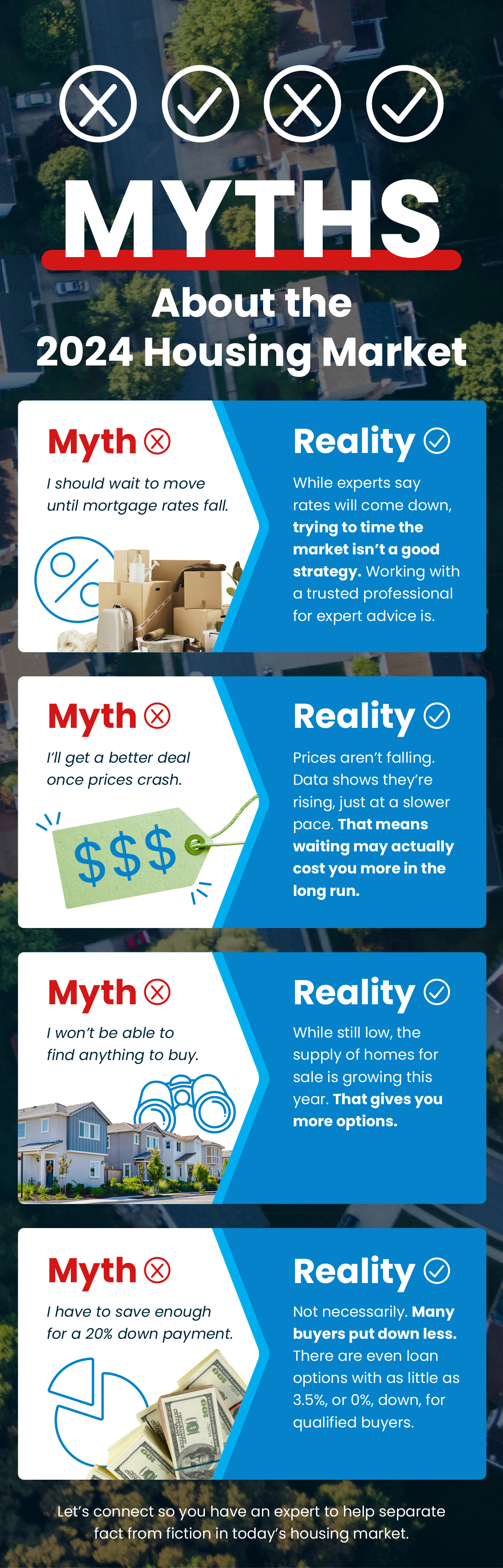
Myths About the 2024 Housing Market [INFOGRAPHIC]

No Caption Received

Some Highlights

  • When it comes to the current housing market, there are some myths circling around right now.
  • Some of the more common ones are that it’s better to wait for mortgage rates to fall or prices to crash. But there are others about the supply of homes for sale and down payments.
  • Let’s connect so you have an expert to help separate fact from fiction in today’s housing market.

The Top 5 Reasons You Need a Real Estate Agent when Buying a Home

You may have heard headlines in the news lately about agents in the real estate industry and discussions about their commissions. And if you’re following along, it can be pretty confusing. But here’s the thing you really need to know – expert advice from a trusted real estate agent is priceless, now more than ever. And here’s why.

A real estate agent does a lot more than you may realize.

Your agent is the person who will guide you through every step when buying a home and look out for your best interests along the way. They smooth out a complex process and take away the bulk of the stress of what’s likely your largest purchase ever. And that’s exactly what you want and deserve.

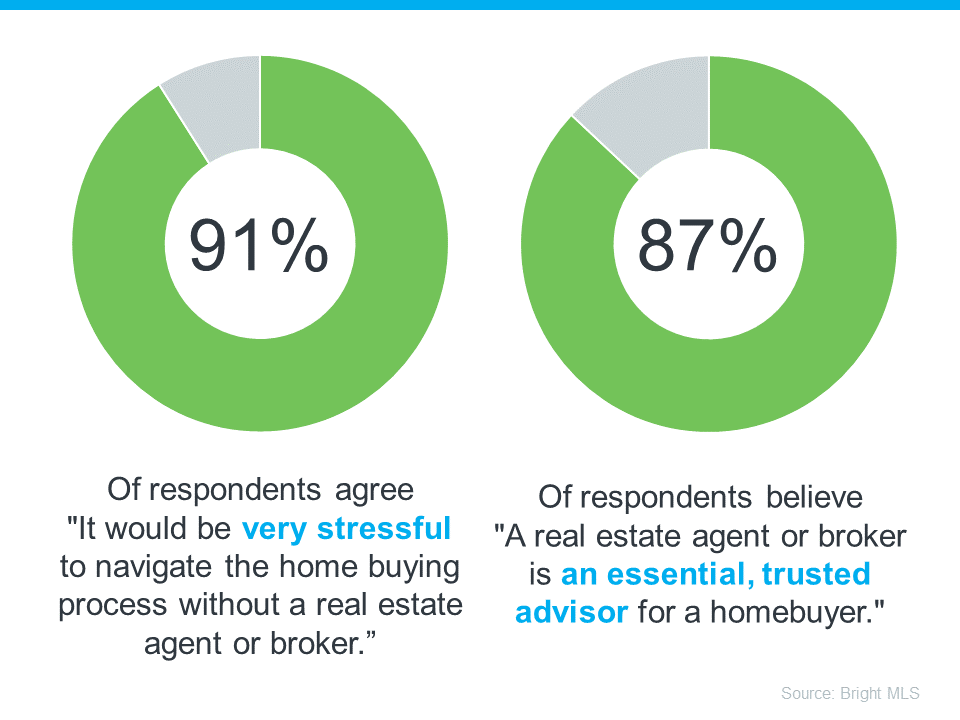
This is at least a part of the reason why a recent survey from Bright MLS found an overwhelming majority of people agree an agent is a key part of the homebuying process (see visual below):

a green and grey pie chart

To give you a better idea of just a few of the top ways agents add value, check out this list.

1. Deliver Industry Experience

The right agent – the professional – will coach you through everything from start to finish. With professional training and expertise, agents know the ins and outs of the buying process. And in today’s complex market, the way real estate transactions are executed is constantly changing, so having the best advice on your side is essential.

2. Provide Expert Local Knowledge

In a world that’s powered by data, a great agent can clarify what it all means, separate fact from fiction, and help you understand how current market trends apply to your unique search. From how quickly homes are selling to the latest listings you don’t want to miss, they can explain what’s happening in your specific local market so you can make a confident decision.

3. Explain Pricing and Market Value

Agents help you understand the latest pricing trends in your area. What’s a home valued at in your market? What should you think about when you’re making an offer? Is this a house that might have issues you can’t see on the surface? No one wants to overpay, so having an expert who really gets true market value for individual neighborhoods is priceless. An offer that’s both fair and competitive in today’s housing market is essential, and a local expert knows how to help you hit the mark.

4. Review Contracts and Fine Print

In a fast-moving and heavily regulated process, agents help you make sense of the necessary disclosures and documents, so you know what you’re signing. Having a professional that’s trained to explain the details could make or break your transaction, and is certainly something you don’t want to try to figure out on your own.

5. Bring Negotiation Expertise

From offer to counteroffer and inspection to closing, there are a lot of stakeholders involved in a real estate transaction. Having someone on your side who knows you and the process makes a world of difference. An agent will advocate for you as they work with each party. It’s a big deal, and you need a partner at every turn to land the best possible outcome.

Bottom Line

Real estate agents are specialists, educators, and negotiators. They adjust to market changes and keep you informed. And keep in mind, every time you make a big decision in your life, especially a financial one, you need an expert on your side.

Expert advice from a trusted professional is priceless. Let’s connect today.

February 2024 Market Update

Note: Data below from February 2024 is the most recent from the National Association of Realtors.

Existing-home sales climbed in February, according to the National Association of REALTORS®. Among the four major U.S. regions, sales jumped in the West, South and Midwest, and were unchanged in the Northeast. Year-over-year, sales declined in all regions.

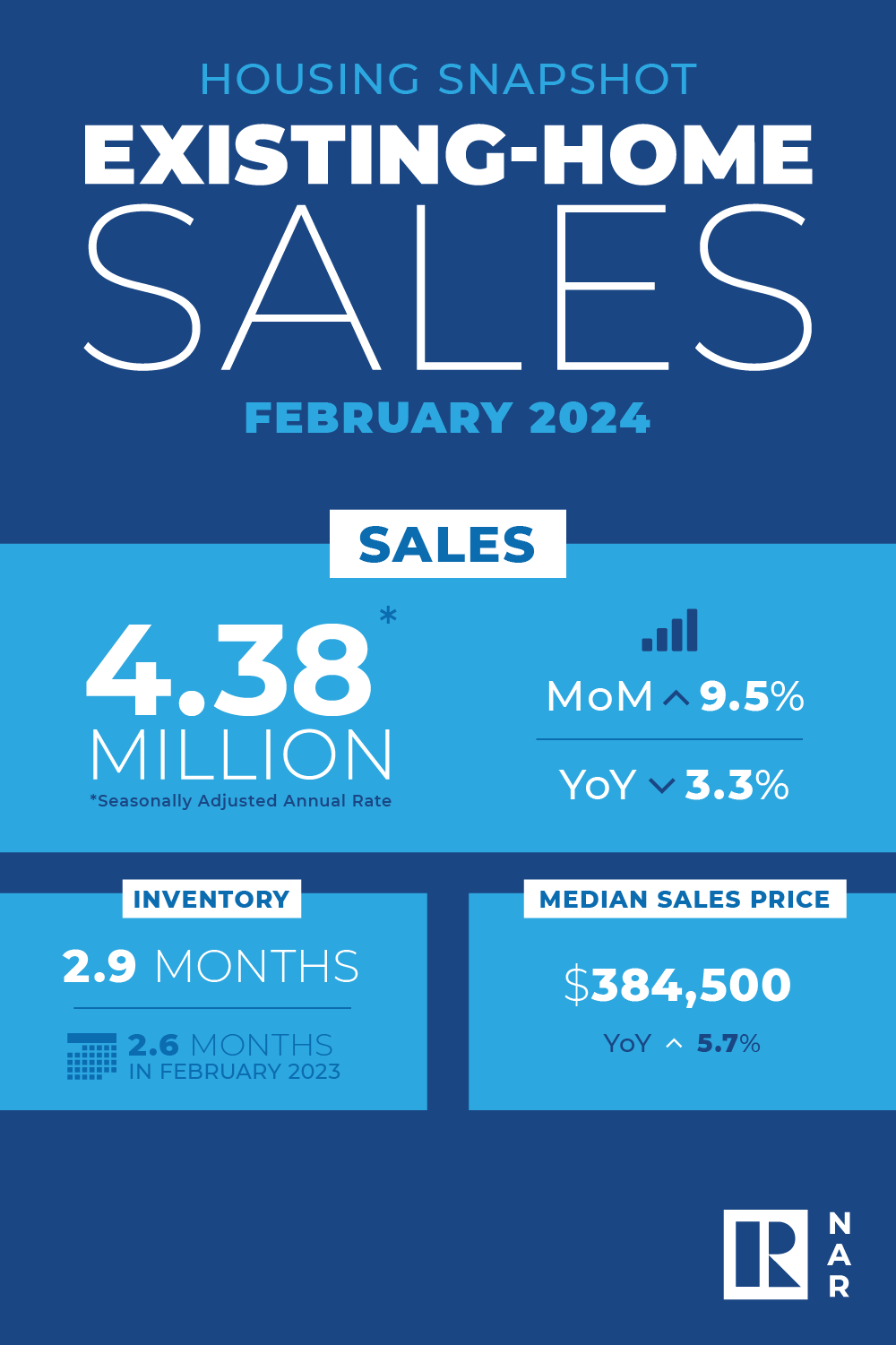
Total existing home sales – completed transactions that include single-family homes, townhomes, condominiums and co-ops – bounced 9.5% from January to a seasonally adjusted annual rate of 4.38 million in February. Year-over-year, sales slid 3.3% (down from 4.53 million in February 2023).

NAR February 2024 Existing Home Sales Report Infographic"Additional housing supply is helping to satisfy market demand," said NAR Chief Economist Lawrence Yun. "Housing demand has been on a steady rise due to population and job growth, though the actual timing of purchases will be determined by prevailing mortgage rates and wider inventory choices."

Total housing inventory registered at the end of February was 1.07 million units, up 5.9% from January and 10.3% from one year ago (970,000). Unsold inventory sits at a 2.9-month supply at the current sales pace, down from 3.0 months in January but up from 2.6 months in February 2023.
 
The median existing-home price for all housing types in February was $384,500, an increase of 5.7% from the prior year ($363,600). All four U.S. regions posted price increases.
 
According to the REALTORS® Confidence Index, properties typically remained on the market for 38 days in February, up from 36 days in January and 34 days in February 2023.
 
First-time buyers were responsible for 26% of sales in February, down from 28% in January and 27% in February 2023. NAR's 2023 Profile of Home Buyers and Sellers – released in November 2024 – found that the annual share of first-time buyers was 32%.
 
All-cash sales accounted for 33% of transactions in February, up from 32% in January and 28% one year ago.
 
Individual investors or second-home buyers, who make up many cash sales, purchased 21% of homes in February, up from 17% in January and 18% in February 2023.
 
According to Freddie Mac, the 30-year fixed-rate mortgage averaged 6.74% as of March 14. That's down from 6.88% the prior week but up from 6.60% one year ago.
 
 
Regional Breakdown
 
At 480,000 units, existing-home sales in the Northeast were identical to January but down 7.7% from February 2023. It's the fourth consecutive month that home sales in the Northeast registered 480,000 units. The median price in the Northeast was $420,600, up 11.5% from one year ago.
 
In the Midwest, existing-home sales propelled 8.4% from one month ago to an annual rate of 1.03 million in February, down 3.7% from the previous year. The median price in the Midwest was $277,600, up 6.8% from February 2023.
 
Existing-home sales in the South leapt 9.8% from January to an annual rate of 2.02 million in February, down 2.9% from one year earlier. The median price in the South was $354,200, up 4.1% from last year.
 
In the West, existing-home sales skyrocketed 16.4% from a month ago to an annual rate of 850,000 in February, a decline of 1.2% from the prior year. The median price in the West was $593,000, up 9.1% from February 2023.
 
"Due to inventory constraints, the Northeast was the regional underperformer in February home sales but the best performer in home prices," Yun added. "More supply is clearly needed to help stabilize home prices and get more Americans moving to their next residences."


January 2024 Market Update

<p>
<span style=”font-family:arial,helvetica,sans-serif;”><span style=”font-size:10pt;”><em><strong>Note: Data below from January 2024 is the most recent from the National Association of Realtors.</strong></em></span></span></p>
<p>
<span style=”font-size:14pt;”><span style=”font-family:arial,helvetica,sans-serif;”>Existing-home sales grew in January, according to the National Association of REALTORS&reg;. Among the four major U.S. regions, sales accelerated in the Midwest, South and West, and remained steady in the Northeast. Year-over-year, sales improved in the West, and decreased in the Northeast, Midwest and South.</span></span></p>
<p>
<span style=”font-size:14pt;”><span style=”font-family:arial,helvetica,sans-serif;”>Total existing home sales&nbsp;&ndash; completed transactions that include single-family homes, townhomes, condominiums and co-ops -&nbsp;elevated 3.1% from December to a seasonally adjusted annual rate of 4.00 million in January. Year-over-year, sales slipped 1.7% (down from 4.07 million in January 2023).</span></span><br />
<br />
<span style=”font-size:14pt;”><span style=”font-family:arial,helvetica,sans-serif;”><img alt=”NAR January 2024 Existing Home Sales Report Infographic” src=”https://www.ihomefinder.com/wp-content/uploads/2024/03/2024-01-existing-home-sales-housing-snapshot-infographic-02-22-2024-1000w-1500h.png” style=”float: right; margin: 4px 10px; height: 321px; width: 214px;” />&quot;While home sales remain sizably lower than a couple of years ago, January's monthly gain is the start of more supply and demand,&quot; said NAR Chief Economist Lawrence Yun. &quot;Listings were modestly higher, and home buyers are taking advantage of lower mortgage rates compared to late last year.&quot;</span></span></p>
<div>
<span style=”font-size:14pt;”><span style=”font-family:arial,helvetica,sans-serif;”>Total housing inventory registered at the end of&nbsp;January was 1.01 million units, up 2.0% from December and 3.1% from one year ago (980,000). Unsold inventory sits at a 3.0-month supply at the current sales pace, down from 3.1 months in December but up from 2.9 months in January 2023.</span></span></div>
<div>
&nbsp;</div>
<div>
<span style=”font-size:14pt;”><span style=”font-family:arial,helvetica,sans-serif;”>The median existing-home price for all housing types in&nbsp;January was $379,100, an increase of 5.1% from one year ago ($360,800). All four U.S. regions posted price increases.</span></span></div>
<div>
&nbsp;</div>
<div>
<span style=”font-size:14pt;”><span style=”font-family:arial,helvetica,sans-serif;”>&quot;The median home price reached an all-time high for the month of January,&quot; Yun added. &quot;Multiple offers are common on mid-priced homes, and many homes were still sold within a month. The elevated share of cash deals &ndash; 32% &ndash; indicated a market full of multiple offers and propelled by record-high housing wealth.&quot;</span></span></div>
<div>
&nbsp;</div>
<div>
<span style=”font-size:14pt;”><span style=”font-family:arial,helvetica,sans-serif;”>According to the REALTORS&reg; Confidence Index, properties typically remained on the market for&nbsp;36 days in January, up from 29 days in December and 33 days in January 2023.</span></span></div>
<div>
&nbsp;</div>
<div>
<span style=”font-size:14pt;”><span style=”font-family:arial,helvetica,sans-serif;”>First-time buyers were responsible for&nbsp;28% of sales in January, down from 29% in December and 31% in January 2023. NAR's 2023 Profile of Home Buyers and Sellers &ndash; released in November 20234 &ndash; found that the annual share of first-time buyers was 32%.</span></span></div>
<div>
&nbsp;</div>
<div>
<span style=”font-size:14pt;”><span style=”font-family:arial,helvetica,sans-serif;”>All-cash sales&nbsp;accounted for&nbsp;32% of transactions in January, up from 29% in both December and one year ago.</span></span><br />
&nbsp;</div>
<div>
<span style=”font-size:14pt;”><span style=”font-family:arial,helvetica,sans-serif;”>Individual investors or second-home buyers, who make up many cash sales, purchased&nbsp;17% of homes in January, up from 16% in December and January 2023.</span></span></div>
<div>
&nbsp;</div>
<div>
<span style=”font-size:16pt;”><span style=”font-size:14pt;”><span style=”font-family:arial,helvetica,sans-serif;”>According to Freddie Mac, the <a href=”https://www.freddiemac.com/pmms” target=”_blank”>30-year fixed-rate mortgage</a> averaged&nbsp;</span></span></span><span style=”font-size:14pt;”><span style=”font-family:arial,helvetica,sans-serif;”>6.77% as of February 15. That's up from 6.64% the previous week and 6.32% one year ago.</span></span></div>
<div>
&nbsp;</div>
<div>
<div>
&nbsp;</div>
<div>
<span style=”font-family:arial,helvetica,sans-serif;”><span style=”font-size:14pt;”><strong>Regional Breakdown</strong></span></span></div>
<div>
&nbsp;</div>
<div>
<div>
<span style=”font-size:14pt;”><span style=”font-family:arial,helvetica,sans-serif;”>At 480,000 units, existing-home sales in the Northeast were unchanged from December but down 5.9% from January 2023. The median price in the Northeast was $434,300, up 10.1% from the prior year.</span></span></div>
<div>
&nbsp;</div>
<div>
<span style=”font-size:14pt;”><span style=”font-family:arial,helvetica,sans-serif;”>In the Midwest, existing-home sales increased 2.2% from one month ago to an annual rate of 950,000 in January, down 3.1% from last year. The median price in the Midwest was $271,700, up 7.6% from January 2023.</span></span></div>
<div>
&nbsp;</div>
<div>
<span style=”font-size:14pt;”><span style=”font-family:arial,helvetica,sans-serif;”>Existing-home sales in the South rose 4.0% from December to an annual rate of 1.84 million in January, a decline of 1.6% from the previous year. The median price in the South was $345,100, up 4.1% from one year ago.</span></span></div>
<div>
&nbsp;</div>
<div>
<span style=”font-size:14pt;”><span style=”font-family:arial,helvetica,sans-serif;”>In the West, existing-home sales elevated 4.3% from a month ago to an annual rate of 730,000 in January and grew 2.8% from one year earlier. The median price in the West was $572,100, up 6.3% from January 2023.</span></span></div>
<div>
&nbsp;</div>
</div>
</div>
<p>
&nbsp;</p>