August 2023 Market Update

Note: Data below from August, 2023 is the most recent from the National Association of Realtors.

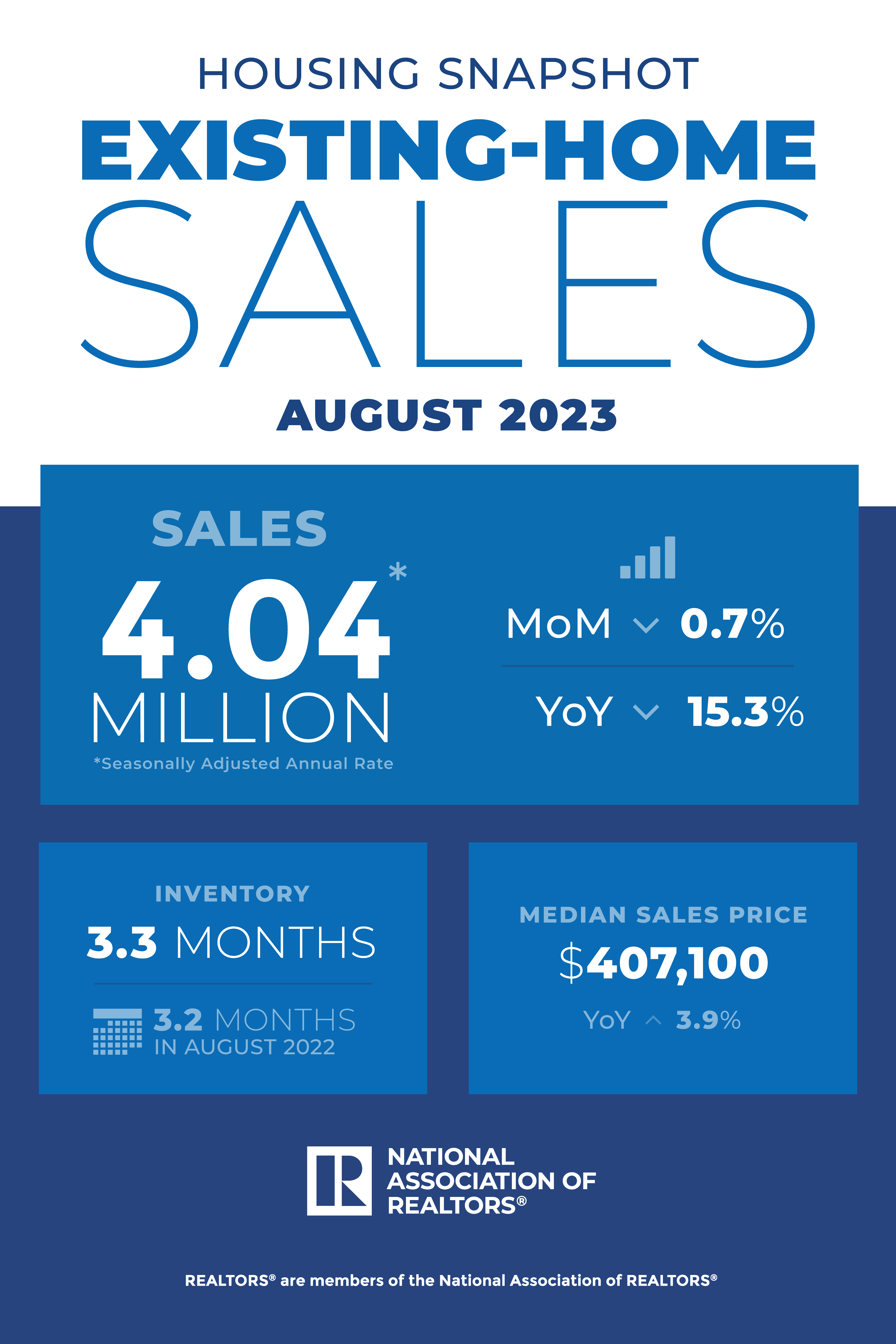
Existing-home sales moved lower in August, according to the National Association of REALTORS®. Among the four major U.S. regions, sales improved in the Midwest, were unchanged in the Northeast, and slipped in the South and West. All four regions recorded year-over-year sales declines.

Total existing home sales – completed transactions that include single-family homes, townhomes, condominiums and co-ops – slid 0.7% from July to a seasonally adjusted annual rate of 4.04 million in August. Year-over-year, sales fell 15.3% (down from 4.77 million in August 2022).

NAR August 2023 Existing Home Sales Report Infographic"Home sales have been stable for several months, neither rising nor falling in any meaningful way," said NAR Chief Economist Lawrence Yun. "Mortgage rate changes will have a big impact over the short run, while job gains will have a steady, positive impact over the long run. The South had a lighter decline in sales from a year ago due to greater regional job growth since coming out of the pandemic lockdown."

Total housing inventory registered at the end of August was 1.1 million units, down 0.9% from July and 14.1% from one year ago (1.28 million). Unsold inventory sits at a 3.3-month supply at the current sales pace, identical to July and up from 3.2 months in August 2022.
 
The median existing-home price for all housing types in August was $407,100, an increase of 3.9% from August 2022 ($391,700). All four U.S. regions posted price increases.
 
"Home prices continue to march higher despite lower home sales," Yun said. "Supply needs to essentially double to moderate home price gains."
 
Properties typically remained on the market for 20 days in August, unchanged from July and up from 16 days in August 2022. Seventy-two percent of homes sold in August were on the market for less than a month.
 
First-time buyers were responsible for 29% of sales in August, down from 30% in July and identical to August 2022. NAR’s 2022 Profile of Home Buyers and Sellers – released in November 2022 – found that the annual share of first-time buyers was 26%, the lowest since NAR began tracking the data.
 
All-cash sales accounted for 27% of transactions in August, up from 26% in July and 24% in August 2022.
 
Individual investors or second-home buyers, who make up many cash sales, purchased 16% of homes in August, the same share as in July and one year ago.
 
According to Freddie Mac, the 30-year fixed-rate mortgage averaged 7.18% as of September 14. That's up from 7.12% the prior week and 6.02% one year ago.
 
 
Regional Breakdown
 
At an annual rate of 480,000 in August, existing-home sales in the Northeast were unchanged from July but down 22.6% from August 2022. The median price in the Northeast was $465,700, up 5.8% from one year ago.
 
In the Midwest, existing-home sales increased by 1.0% from the previous month to an annual rate of 970,000 in August, down 16.4% from the prior year. The median price in the Midwest was $305,300, up 6.8% from August 2022.
 
Existing-home sales in the South faded 1.1% from July to an annual rate of 1.84 million in August, a decrease of 12.4% from one year ago. The median price in the South was $366,100, up 3.2% from August 2022.
 
In the West, existing-home sales slumped 2.6% from the previous month to an annual rate of 750,000 in August, down 15.7% from the prior year. The median price in the West was $609,300, up 1.0% from August 2022.


The Difference Between Renting and Buying a Home [INFOGRAPHIC]

The Difference Between Renting and Buying a Home [INFOGRAPHIC] | North Scottsdale Real Estate & Luxury Homes | Team Picarello

The Difference Between Renting and Buying a Home [INFOGRAPHIC] | North Scottsdale Real Estate & Luxury Homes | Team Picarello

Some Highlights

Home Prices Are Not Falling

During the fourth quarter of last year, some housing experts projected home prices were going to crash in 2023. The media ran with those forecasts and put out headlines calling for doom and gloom in the housing market. All of this negative news coverage made a lot of people have doubts about the strength of the residential real estate market.

If it made you question if you should delay your own plans to move, here’s what you really need to know.

Home Prices Never Crashed

Disregard what you saw in the headlines. The actual data shows home prices were remarkably resilient and performed far better than the media would have you believe (see graph below):

Home Prices Are Not Falling | North Scottsdale Real Estate & Luxury Homes | Team Picarello

This graph uses reports from three trusted sources to clearly illustrate prices have already rebounded after experiencing only slight declines nationally. That’s a far cry from the crash so many articles called for.

The declines that did happen (shown in red), weren’t drastic but were short-lived. As Nicole Friedman, a reporter at the Wall Street Journal (WSJ), says:

“Home prices aren’t falling anymore. . . The surprisingly quick recovery suggests that the residential real-estate downturn is turning out to be shorter and shallower than many housing economists expected . . .”

Even though some media coverage made a big deal about home prices pulling back, the slight correction that happened is already in the rearview mirror. Basically, this data shows you home prices aren’t falling anymore – they’re actually going back up.

What’s Next for Home Prices?

The consensus from experts is that home price growth will continue in the years ahead and is returning to normal levels for the market. That means we’ll still see home prices appreciating, just at a slower pace than the last few years – and that’s a good thing.

Some news sources will see home price growth slowing and put out stories that make you think prices are falling again. The return of misleading headlines like those is already having an impact on how homebuyers are feeling again. You can see how this affects general opinion in the Consumer Confidence Survey from Fannie Mae (see graph below):

Home Prices Are Not Falling | North Scottsdale Real Estate & Luxury Homes | Team Picarello

While the percentage of Americans who think prices will fall has been slowly declining this year, the latest Consumer Confidence data indicates that’s ticked back up recently (shown in red). This change is surprising especially since the home price data shows prices are going up, not down. It tells you the impact the media still has on public opinion.

Don’t fall for the negative headlines and become part of this statistic. Remember, data from a number of sources shows home prices aren’t falling anymore.

Bottom Line

Even though the media may make things sound doom and gloom, the data shows home prices aren’t falling anymore. So, don’t let the headlines scare you or delay your plans. Let’s connect so you have a trusted resource to cut through the noise and tell you what’s really happening in our area.

July 2023 Market Update

Note: Data below from July, 2023 is the most recent from the National Association of Realtors.

Existing-home sales receded in July, according to the National Association of Realtors®. Among the four major U.S. regions, sales grew in the West but faded in the Northeast, Midwest and South. All four regions registered year-over-year sales declines.
 
Total existing-home sales – completed transactions that include single-family homes, townhomes, condominiums and co-ops – waned 2.2% from June to a seasonally adjusted annual rate of 4.07 million in July. Year-over-year, sales slumped 16.6% (down from 4.88 million in July 2022).
 
“Two factors are driving current sales activity – inventory availability and mortgage rates,” said NAR Chief Economist Lawrence Yun. “Unfortunately, both have been unfavorable to buyers.”
 
Total housing inventory registered at the end of July was 1.11 million units, up 3.7% from June but down 14.6% from one year ago (1.3 million). Unsold inventory sits at a 3.3-month supply at the current sales pace, up from 3.1 months in June and 3.2 months in July 2022.
 
The median existing-home price for all housing types in July was $406,700, an increase of 1.9% from July 2022 ($399,000). Prices rose in the Northeast, Midwest and South but were unchanged in the West.
 
“Most homeowners continue to enjoy large wealth gains from recent years with little concern about home price declines,” Yun said. “However, many renters are concerned as they’re facing growing affordability challenges because of high interest rates.”
 
According to the REALTORS® Confidence Index, properties typically remained on the market for 20 days in July, up from 18 days in June and 14 days in July 2022. Seventy-four percent of homes sold in July were on the market for less than a month.
 
First-time buyers were responsible for 30% of sales in July, up from 27% in June and 29% in July 2022. NAR’s 2022 Profile of Home Buyers and Sellers – released in November 20224 – found that the annual share of first-time buyers was 26%, the lowest since NAR began tracking the data.
 
All-cash sales accounted for 26% of transactions in July, identical to June but up from 24% in July 2022.
 
Individual investors or second-home buyers, who make up many cash sales, purchased 16% of homes in July, down from 18% in June but up from 14% one year ago.
 
According to Freddie Mac, the 30-year fixed-rate mortgage averaged 7.09% as of August 17. That’s up from 6.96% the prior week and 5.13% one year ago.
 
“Retreating mortgage rates will bring more buyers and sellers to the market and get Americans moving again,” Yun said.
 
 
Regional Breakdown
 
Existing-home sales in the Northeast descended 5.9% from June to an annual rate of 480,000 in July, down 23.8% from July 2022. The median price in the Northeast was $467,500, up 5.5% from one year ago.
 
In the Midwest, existing-home sales decreased by 3.0% from the prior month to an annual rate of 960,000 in July, dropping 20.0% from the previous year. The median price in the Midwest was $304,600, up 3.9% from July 2022.
 
Existing-home sales in the South retracted 2.6% from June to an annual rate of 1.86 million in July, a decrease of 14.3% from one year ago. The median price in the South was $366,200, up 1.7% from July 2022.
 
In the West, existing-home sales increased 2.7% from the previous month to an annual rate of 770,000 in July, down 12.5% from the prior year. The median price in the West was $610,500, unchanged from July 2022.


The Many Non-Financial Benefits of Homeownership

Buying and owning your own home can have a big impact on your life. While there are financial reasons to become a homeowner, it’s essential to think about the non-financial benefits that make a home more than just a place to live.

Here are some of the top non-financial reasons to buy a home.

According to Fannie Mae, 94% of survey respondents say “Having Control Over What You Do with Your Living Space” is a top reason to own.

Your home is truly your own space. If you own a home, unless there are specific homeowner association requirements, you can decorate and change it the way you like. That means you can make small changes or even do big renovations to make your home perfect for you. Your home is uniquely yours and by buying, you give yourself the freedom to tailor it to your individual style. Investopedia explains:

“One often-cited benefit of homeownership is the knowledge that you own your little corner of the world. You can customize your house, remodel, paint, and decorate without the need to get permission from a landlord.”

When you rent, you might not be able to make your place really feel like it’s yours. And if you do make any modifications, you might have to change them back before you leave. But if you own your home, you can make it just the way you want it. That level of customization can give you a sense of pride in where you live and make you feel more connected to it.

Fannie Mae also finds 90% say “Having a Good Place for Your Family To Raise Your Children” tops their list of why it’s better to buy a home.

Another important factor to think about is what stage of life you’re in. U.S. News breaks it down:

“For those with young children, buying a home and putting down roots is a major driver. . . . You don’t want the upheaval of a massive rent increase or a non-renewed lease to impact your sense of stability.”

No matter which of life’s milestones you’re in, stability and predictability are important. That’s because the one constant in life is that things will change. And, as life changes around you, having a familiar home and not worrying about moving regularly helps you and those who matter most feel more secure and more comfortable.

Lastly, Fannie Mae says 82% list “Feeling Engaged in Your Community” as another key motivator to own.

Owning your home also helps you feel even more connected to your neighborhood. People who own homes usually live in them for an average of nine years, according to the National Association of Realtors (NAR). As that time passes, it’s natural to make friends and build strong ties in the community. As Gary Acosta, CEO and Co-Founder at the National Association of Hispanic Real Estate Professionals (NAHREP), points out:

“Homeowners also tend to be more active in their local communities . . .”

When you care deeply about the people you live near, you’ll do what you can to contribute to your local area.

Bottom Line

Owning your home can make your life better by giving you a sense of accomplishment, pride, stability, and connectedness. If you’re thinking about becoming a homeowner and want to learn more, let’s connect.

Buyer Traffic Is Still Stronger than the Norm

Are you putting off selling your house because you’re worried no one’s buying because of where mortgage rates are? If so, know this: the latest data shows plenty of buyers are still out there, and they’re purchasing homes today. Here’s the data to prove it.

The ShowingTime Showing Index is a measure of buyers touring homes. The graph below uses the latest numbers available and compares them to the same month in the last normal years to show just how active today’s buyers still are:

As you can see, when June 2023 numbers are stacked alongside what’s typical for the housing market at this time of year, it’s clear buyers are still active. And, they’re actually a lot more active than the norm.

If you’re wondering how this could possibly be true, it’s because buyers are getting used to higher mortgage rates and accepting them as the new reality. As Danielle Hale, Chief Economist, Realtor.com, explains:

“Interest rate hikes continue to further cut into buyers’ purchasing power, although they appear to have adapted to the higher mortgage rate environment . . .”
It’s simple. Buyers will always need to buy, and those who can afford to move at today’s rates are going to do so.

The Key Takeaway for You
While it’s true things have slowed down from the frenzy of the last couple of years, it doesn’t mean today’s market is at a standstill. The reality is: buyer traffic is still strong today. Even with today’s mortgage rates, plenty of buyers are still making their moves. So why delay your own move when there’s clearly a market for your house?

Bottom Line
Don’t put off your plans because you’re worried no one will buy your home. The opposite is true, and more buyers are more active than the norm. Let’s connect to get your house ready to sell, so it makes the best first impression possible on those eager buyers.

Why You Need a True Expert in Today’s Housing Market

The housing market continues to shift and change, and in a fast-moving landscape like we’re in right now, it’s more important than ever to have a trusted real estate agent on your side. Whether you’re buying your first home or selling once again, it’s mission critical to work with an expert who can guide you through each unique step of the process.

The reality is, not all agents operate the same way. To truly make a powerful and confident decision as you buy or sell a home, you need a real estate expert who uses their knowledge of what’s really happening with home prices, housing supply, industry projections, and more to give you the best possible advice. Someone who can provide clarity and trust like that is essential to your success. Jay Thompson, Real Estate Industry Consultant, explains:

“Housing market headlines are everywhere. Many are quite sensational, ending with exclamation points or predicting impending doom for the industry. Clickbait, the sensationalizing of headlines and content, has been an issue since the dawn of the internet, and housing news is not immune to it.”

Unfortunately, when information in the media isn’t clear, it can generate a lot of fear and uncertainty for consumers. As Jason Lewris, Co-Founder and Chief Data Officer at Parcl, says:

“In the absence of trustworthy, up-to-date information, real estate decisions are increasingly being driven by fear, uncertainty, and doubt.”

But it doesn’t have to be that way. Buying a home is a big decision, and it should be one you feel confident making. You can lean on an expert to help you separate fact from fiction and get the answers you need.

The right agent can assist you in figuring out what’s going on at the national level and in your local area. They can debunk headlines using data you can trust. Experts have in-depth knowledge of the industry and can provide context, so you know how current trends compare to the normal ebbs and flows in the housing market, historical data, and more.

Then, to make sure you have the full picture, an agent can tell you if your local area is following the national trend or if they’re seeing something different in your market. Together, you can use all that information to make the best possible decision.

After all, making a move is a potentially life-changing milestone. It should be something you feel ready for and excited about. And that’s where a trusted expert comes in.

Bottom Line

If you want sound advice and trusted information about our local housing market, let’s connect.

Don’t Expect a Wave of Foreclosures

Don't Expect a Wave of Foreclosures | North Scottsdale Real Estate & Luxury Homes | Team Picarello

Some Highlights

  • With ongoing high inflation pushing up everyday costs, some people are worried that’ll create a flood of foreclosures. Here’s why that’s unlikely.
  • Fewer people are seriously behind on mortgage payments right now. If foreclosures were going to rise a lot, more people would need to be late on their payments.
  • Since most are paying on time, a wave isn’t coming. If you’re concerned about a flood of foreclosures, the data shows that’s not likely.

June 2023 Market Update

Note: Data below from June, 2023 is the most recent from the National Association of Realtors.

Existing-home sales slipped in June, according to the National Association of REALTORS®. Sales varied among the four major U.S. regions, with the Northeast experiencing gains, the Midwest holding steady, and the South and West posting decreases. All four regions recorded year-over-year sales declines.

Total existing home sales – completed transactions that include single-family homes, townhomes, condominiums and co-ops – receded 3.3% from May to a seasonally adjusted annual rate of 4.16 million in June. Year-over-year, sales fell 18.9% (down from 5.13 million in June 2022).

NAR June 2023 Existing Home Sales Report Infographic"The first half of the year was a downer for sure with sales lower by 23%," said NAR Chief Economist Lawrence Yun. "Fewer Americans were on the move despite the usual life-changing circumstances. The pent-up demand will surely be realized soon, especially if mortgage rates and inventory move favorably."

Total housing inventory registered at the end of June was 1.08 million units, identical to May but down 13.6% from one year ago (1.25 million). Unsold inventory sits at a 3.1-month supply at the current sales pace, up from 3.0 months in May and 2.9 months in June 2022.
 
"There are simply not enough homes for sale," Yun added. "The market can easily absorb a doubling of inventory."
 
The median existing-home price for all housing types in June was $410,200, the second-highest price of all time and down 0.9% from the record-high of $413,800 in June 2022. The monthly median price surpassed $400,000 for the third time, joining June 2022 and May 2022 ($408,600). Prices rose in the Northeast and Midwest but waned in the South and West.
 
"Home sales fell but home prices have held firm in most parts of the country," Yun said. "The national median home price in June was slightly less than the record high of nearly $414,000 in June of last year. Limited supply is still leading to multiple-offer situations, with one-third of homes getting sold above the list price in the latest month."
 
Properties typically remained on the market for 18 days in June, identical to May but up from 14 days in June 2022. Seventy-six percent of homes sold in June were on the market for less than a month.
 
First-time buyers were responsible for 27% of sales in June, down from 28% in May and 30% in June 2022. NAR’s 2022 Profile of Home Buyers and Sellers – released in November 2022 – found that the annual share of first-time buyers was 26%, the lowest since NAR began tracking the data.
 
All-cash sales accounted for 26% of transactions in June, up from 25% in both May 2023 and June 2022.
 
Individual investors or second-home buyers, who make up many cash sales, purchased 18% of homes in June, up from 15% in May and 16% the previous year.
 
According to Freddie Mac, the 30-year fixed-rate mortgage averaged 6.96% as of July 13. That's up from 6.81% the previous week and 5.51% one year ago.
 
 
Regional Breakdown
 
Existing-home sales in the Northeast grew 2.0% from May to an annual rate of 510,000 in June, down 21.5% from June 2022. The median price in the Northeast was $475,300, up 4.9% from the prior year.
 
In the Midwest, existing-home sales were unchanged from one month ago at an annual rate of 990,000 in June, slumping 19.5% from one year ago. The median price in the Midwest was $311,800, up 2.1% from June 2022.
 
Existing-home sales in the South faded 5.4% from May to an annual rate of 1.91 million in June, a decrease of 16.2% from the previous year. The median price in the South was $366,600, down 1.2% from June 2022.
 
In the West, existing-home sales declined 5.1% from the previous month to an annual rate of 750,000 in June, down 22.7% from one year ago. The median price in the West was $606,500, down 3.4% from June 2022.

 

About 11,000 Houses Will Sell Today

Some homeowners have been waiting for months to put their house on the market because they don’t think people are buying homes right now. If that’s you, know that even though the housing market has slowed compared to the frenzy of a couple of years ago, it isn’t at a standstill. Contrary to what you may believe, buyers are still active and plenty of homes are selling right now.

According to the National Association of Realtors (NAR), based on the pace of sales right now, just over 4 million homes will sell this year. With some simple math, let’s break down what that really means for you:

  • 4.16 million homes divided by 365 days in a year = 11,397 houses sell each day
  • 11,397 divided by 24 hours in a day = 475 houses sell per hour
  • 475 divided by 60 minutes in an hour = about 8 houses sell each minute

So, on average, about 11,000 homes sell each day in this country.

A real estate expert can give you more information about how many houses are being sold in your neighborhood, the amazing advantages that sellers are experiencing right now, and the most important things buyers are searching for in your area. Together you’ll use this knowledge to shape how you market your house based on local trends.

Bottom Line

If you’ve been waiting to sell because you don’t think there are buyers out there, know today’s market is active. Every day you wait, around 11,000 other homeowners are selling. In the time it took you to read this, eight homes sold. When you’re ready to sell too, let’s connect.