Housing Market Forecast: What’s Ahead for the 2nd Half of 2024

As we move into the second half of 2024, here’s what experts say you should expect for home prices, mortgage rates, and home sales.

Home Prices Are Expected To Climb Moderately

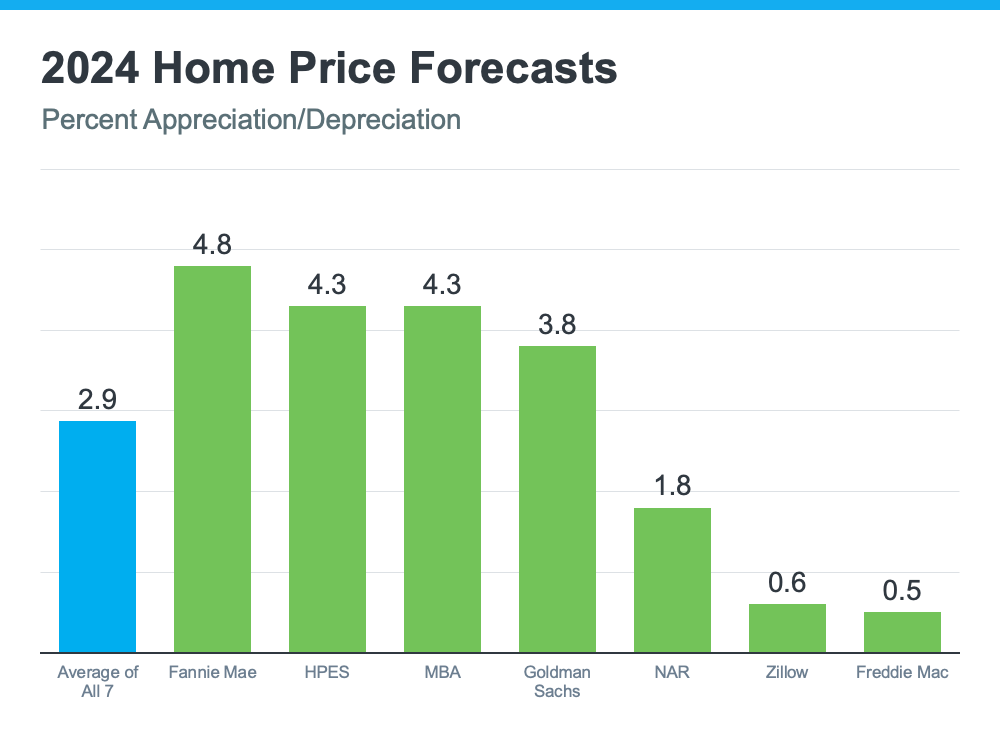
Home prices are forecasted to rise at a more normal pace. The graph below shows the latest forecasts from seven of the most trusted sources in the industry:
No Caption Received

The reason for continued appreciation? The supply of homes for sale. Jessica Lautz, Deputy Chief Economist at the National Association of Realtors (NAR), explains:

“One thing that seems to be pretty solid is that home prices are going to continue to go up, and the reason is that we don’t have housing inventory.”

While inventory is up compared to the last couple of years, it’s still low overall. And because there still aren’t enough homes to go around, that’ll keep upward pressure on prices.

If you’re thinking of buying, the good news is you won’t have to deal with prices skyrocketing like they did during the pandemic. Just remember, prices aren’t expected to drop. They’ll continue climbing, just at a slower pace.

So, getting into the market sooner rather than later could still save you money in the long run. Plus, you can feel confident experts say your home will grow in value after you buy it.

Mortgage Rates Are Forecast To Come Down Slightly

One of the best pieces of news for both buyers and sellers is that mortgage rates are expected to come down a bit, according to Fannie Mae, the Mortgage Bankers Association (MBA), and NAR (see chart below):
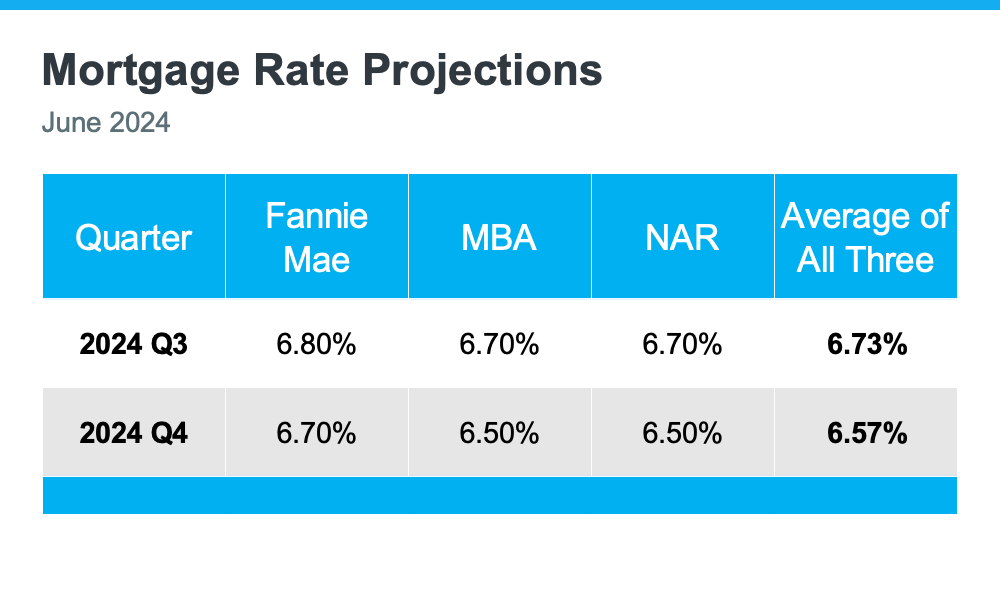
No Caption ReceivedWhen you buy, even a small drop in mortgage rates can make a big difference in your monthly payments. For sellers, lower rates will bring more buyers back into the market, which can help you sell faster and potentially at a higher price. Plus, it may help you get off the fence, if you’ve been hesitant to sell due to today’s rates.

Home Sales Are Projected To Hold Steady

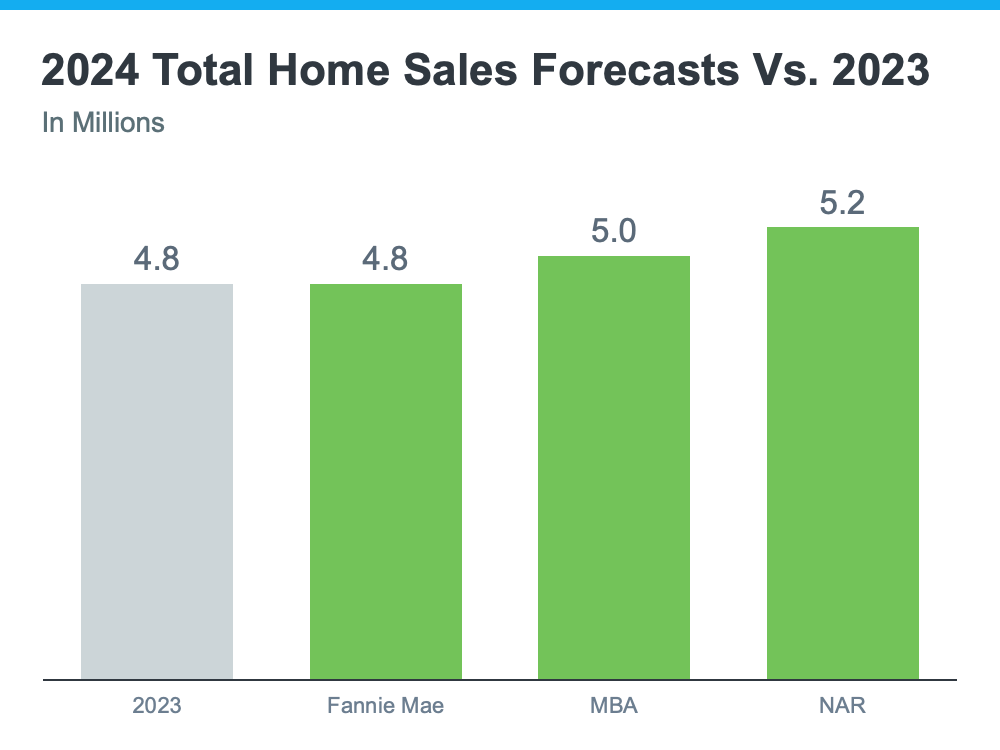
For 2024, the number of home sales will be about the same as last year and may even rise slightly. The graph below compares the 2024 home sales forecasts from Fannie Mae, MBA, and NAR to the 4.8 million homes that sold last year:
No Caption Received

The average of the three forecasts is about 5 million sales in 2024 – a small increase from 2023. Lawrence Yun, Chief Economist at NAR, explains why:

“Job gains, steady mortgage rates and the release of inventory from pent-up home sellers will lead to more sales.”

With more inventory available and mortgage rates expected to go down, a few more homes are expected to be sold this year compared to last year. This means more people will be able to move. Let’s work together to make sure you’re one of them.

Bottom Line

If you have any questions or need help navigating the market, reach out.

Home Prices Aren’t Declining, But Headlines Might Make You Think They Are

If you’ve seen the news lately about home sellers slashing prices, it’s a great example of how headlines do more to terrify than clarify. Here’s what’s really happening with prices.

The bottom line is home prices are higher than they were a year ago at this time, and they’re expected to keep rising, just at a slower pace.

But a recent article from Redfin notes,

“Price Drops Hit Highest Level in 18 Months As High Rates Dampen Buyer Demand.”

And that might make you think prices are declining.

Now, while it’s true the latest report from Realtor.com also shows 16.6% of homes on the market had price reductions in May, which is up from 12.7% last May, that doesn’t mean overall home prices are falling.

The key is knowing the difference between the asking price and the sold price.

Understanding Asking Price vs. Sold Price

In essence, the asking price, also known as a listing price, is the amount a seller hopes to get for their home when they list it. In reality, sellers can’t just put any price tag on their house and expect it to sell for top dollar. Today’s buyers are savvy customers, and when they aren’t willing to pay a premium for a home because their budgets are strained by higher mortgage rates, sellers need to adjust. And that’s what’s happening right now.

Based on market factors and what offers that seller receives, that asking price can change. If a seller isn’t getting much foot traffic, you may see them revise the price and make an adjustment to reignite interest in the home – and sometimes that’s because they’ve overpriced it from the start. That’s where price reductions come in, and when you see “price drops” in a headline, it sounds like declining home prices.

Mike Simonsen, CEO and Founder of Altos Research, says:

“Not only is the share of homes with price cuts elevated compared to one year ago, but more price cuts are happening each week than last year.”

On the other hand, the final sold price is the amount a buyer actually pays when the transaction is complete.

Here’s the most important thing to note: Actual sold prices are still rising, and they’re expected to continue to do so at least over the next 5 years.

What Does This Mean for Home Prices?

So, while there’s been an increase in price reductions recently, this doesn’t mean overall home values are declining. Instead, it’s a sign that demand is moderating. And, as a result, sellers are adjusting their expectations to align with today’s market reality.

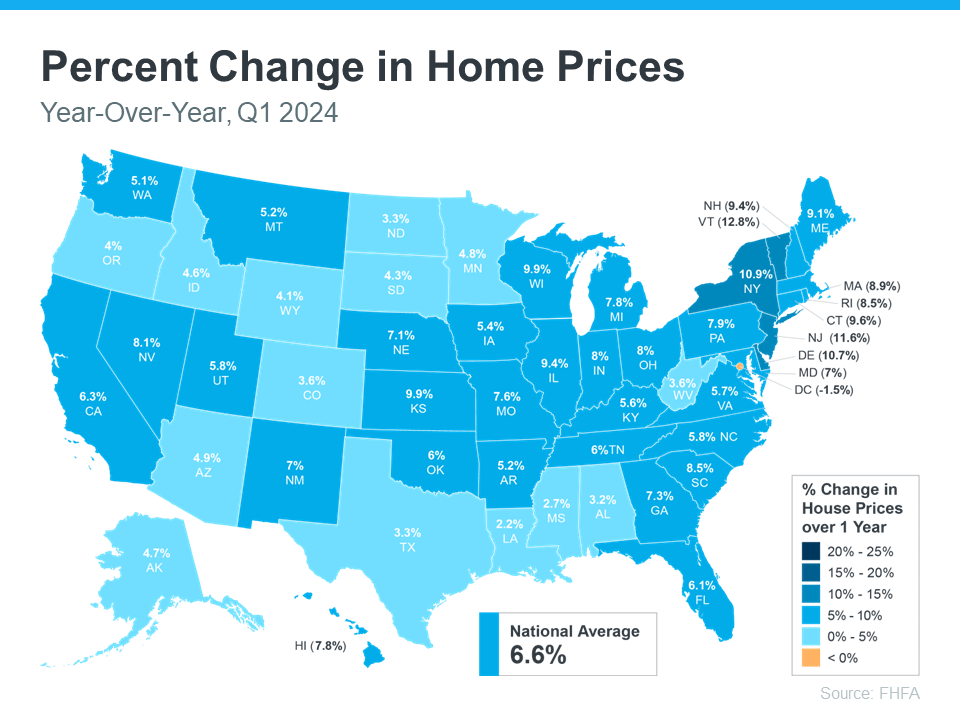
Even with more price reductions, home values are still growing on an annual basis, as they do nearly every year in the housing market. According to the Federal Housing Finance Agency (FHFA), home prices went up 6.6% over the last year (see below):No Caption Received

This map shows how prices rose just about everywhere in the country, indicating the market is not in decline.

So, while seller price reductions are often a leading indicator that prices may moderate in the months ahead, which experts have been saying for a while is expected to happen, they aren’t necessarily reason for alarm. The same article from Redfin also states:

“. . .those metrics suggest sale-price growth could soften in the coming months as persistently high mortgage rates turn off homebuyers. For now, the median-home sale price is up 4.3% year over year to another record high. . .”

And with inventory as tight as it is today, price moderation is much more likely in upcoming months than price declines.

Why This Is Good News for Buyers and Sellers

For buyers, more realistic asking prices mean a better chance of securing a home at a fair price. It also means you can enter the market with more confidence, knowing prices are stabilizing rather than continuing to skyrocket.

For sellers, understanding the need to adjust your asking price can lead to faster sales and fewer price negotiations. Setting a realistic price from the start can attract more serious buyers and lead to smoother transactions.

Bottom Line

While the uptick in price reductions might seem troubling, it’s not a cause for concern. It reflects a market adjusting to new conditions. Home prices are continuing to grow, just at a more moderate pace.

April 2024 Market Report

<p>
<span style=”font-size:10pt;”><em><strong>Note: April 2024 data below are the most recent released by the National Association of Realtors.</strong></em></span></p>
<p>
Total existing-home sales (completed transactions that include single-family homes, townhomes, condominiums and co-ops) receded in April, according to the National Association of REALTORS&reg;. All four major U.S. regions posted month-over-month declines. Year-over-year, sales decreased in the Northeast, Midwest and South but increased in the West.</p>
<p>
<a href=”https://www.ihomefinder.com/wp-content/uploads/2024/06/2024-04-existing-home-sales-housing-snapshot-infographic-05-22-2024-1000w-1500h.png” target=”_blank”><img alt=”National Association of Realtors April 2024 Data” src=”https://www.ihomefinder.com/wp-content/uploads/2024/06/2024-04-existing-home-sales-housing-snapshot-infographic-05-22-2024-1000w-1500h.png” style=”width: 350px; height: 541px; float: right; margin-left: 15px; margin-bottom: 5px;” /></a></p>
<div>
<div>
&quot;Home sales changed little overall, but the upper-end market is experiencing a sizable gain due to more supply coming onto the market,&quot; said NAR Chief Economist Lawrence Yun.</div>
</div>
<p>
Total housing inventory at the end of April was 1.21 million units, up 9% from March and 16.3% from one year ago (1.04 million). Unsold inventory sits at a 3.5-month supply at the current sales pace, up from 3.2 months in March and 3.0 months in April 2023. For homes priced $1 million or more, inventory and sales increased by 34% and 40%, respectively, from a year ago.</p>
<div>
The median existing-home price for all housing types in April was $407,600, an increase of 5.7% from the previous year ($385,800). All four U.S. regions registered price gains.</div>
<div>
&nbsp;</div>
<div>
&quot;Home prices reaching a record high for the month of April is very good news for homeowners,&quot; Yun added. &quot;However, the pace of price increases should taper off since more housing inventory is becoming available.</div>
<div>
&nbsp;</div>
<div>
According to the monthly <a href=”https://www.nar.realtor/research-and-statistics/research-reports/realtors-confidence-index” target=”_blank”>REALTORS&reg; Confidence Index</a>, properties typically remained on the market for 26 days in April, down from 33 days in March but up from 22 days in April 2023.</div>
<p>
First-time buyers were responsible for 33% of sales in April, up from 32% in March and 29% in April 2023. NAR's 2023 <a href=”https://www.nar.realtor/research-and-statistics/research-reports/highlights-from-the-profile-of-home-buyers-and-sellers” target=”_blank”>Profile of Home Buyers and Sellers</a> &ndash; released in November 20234 &ndash; found that the annual share of first-time buyers was 32%.</p>
<p>
All-cash sales accounted for 28% of transactions in April, identical to March and one year ago.</p>
<div>
<div>
<div>
Individual investors or second-home buyers, who make up many cash sales, purchased 16% of homes in April, up from 15% in March but down from 17% in April 2023.</div>
</div>
<div>
&nbsp;</div>
</div>
<div>
<div>
According to Freddie Mac, the <a href=”https://www.freddiemac.com/pmms”>30-year fixed-rate mortgage</a> averaged 7.02% as of May 16. That's down from 7.09% the previous week but up from 6.39% one year ago.</div>
<div>
&nbsp;</div>
<div>
&nbsp;</div>
</div>
<div>
<span style=”font-size:14pt;”><strong>Regional Breakdown</strong></span><br />
&nbsp;</div>
<div>
<div>
<div>
<div>
<div>
<div>
Existing-home sales in the Northeast waned 4% from March to an annual rate of 480,000 in April, a decline of 4% from April 2023. The median price in the Northeast was $458,500, up 8.5% from the previous year.</div>
<div>
&nbsp;</div>
<div>
In the Midwest, existing-home sales slipped 1% from one month ago to an annual rate of 1 million in April, down 1% from one year ago. The median price in the Midwest was $303,600, up 6% from April 2023.</div>
<div>
&nbsp;</div>
<div>
Existing-home sales in the South descended 1.6% from March to an annual rate of 1.9 million in April, down 3.1% from the prior year. The median price in the South was $366,200, up 3.7% from last year.</div>
<div>
&nbsp;</div>
<div>
In the West, existing-home sales retracted 2.6% from a month ago to an annual rate of 760,000 in April, an increase of 1.3% from one year before. The median price in the West was $629,600, up 9.3% from April 2023.</div>
</div>
</div>
</div>
</div>
<p>
&nbsp;</p>
</div>