Owning a Home Helps Protect Against Inflation

You’re probably feeling the impact of high inflation every day as prices have gone up on groceries, gas, and more. If you’re a renter, you’re likely experiencing it a lot as your rent continues to rise. Between all of those elevated costs and uncertainty about a potential recession, you may be wondering if it still makes sense to buy a home today. The short answer is – it does. Here’s why.

Homeownership actually shields you from the rising costs inflation brings.

Freddie Mac explains how:

“Not only will buying today help you begin to build equity, a fixed-rate mortgage can stabilize your monthly housing costs for the long-term even while other life expenses continue to rise – as has been the case the past few years.”

Unlike rents, which tend to rise with time, a fixed-rate mortgage payment is predictable over the life of the mortgage (typically 15 to 30 years). And, when the cost of most everything else is rising, keeping your housing payment stable is especially important.

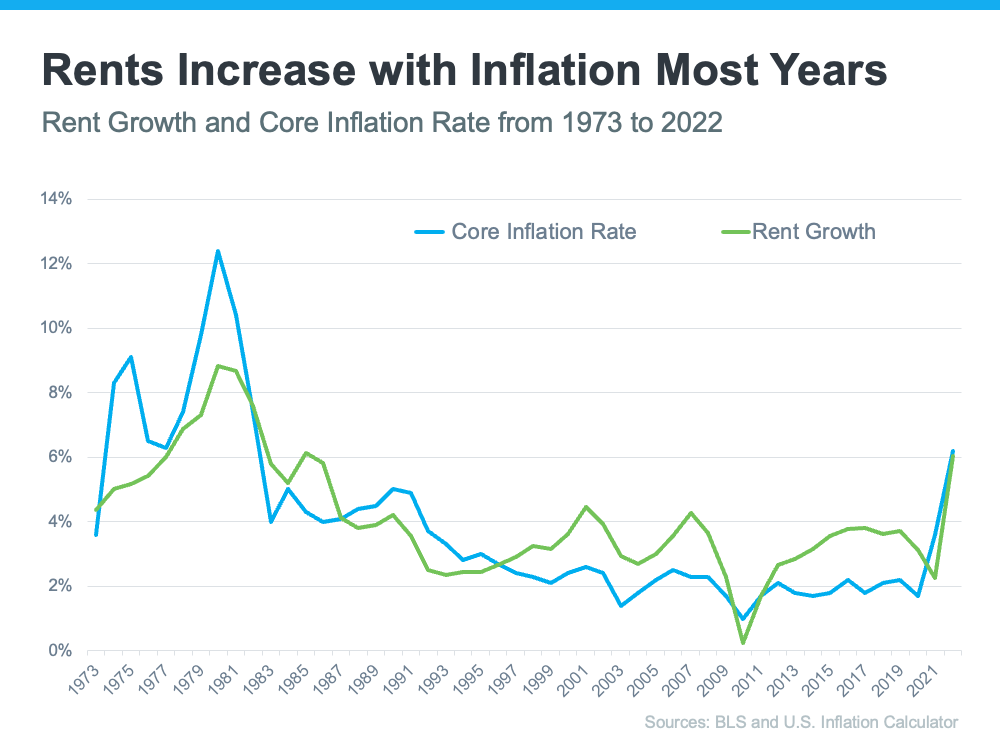
The alternative to homeownership is renting – and rents tend to move alongside inflation. That means as inflation goes up, your monthly rent payments tend to go up, too (see graph below):
Owning a Home Helps Protect Against Inflation | North Scottsdale Real Estate & Luxury Homes | Team Picarello

A fixed-rate mortgage allows you to protect yourself from future rent hikes. With inflation still high, when your rental agreement comes up for renewal, your property manager may decide to increase your payments to offset the impact of inflation. Maybe that’s why, according to a recent survey, 73% of property managers plan to raise rents over the next two years.

Having your largest monthly expense remain stable in a time of economic uncertainty is a major perk of homeownership. If you continue to rent, you don’t have that same benefit and aren’t as protected from rising costs.

Bottom Line

A stable housing payment is especially important in times of high inflation. Let’s connect so you can learn more and start your journey to homeownership today.
What You Need To Know About Home Price News

The National Association of Realtors (NAR) will release its latest Existing Home Sales Report tomorrow. The information it contains on home prices may cause some confusion and could even generate some troubling headlines. This all stems from the fact that NAR will report the median sales price, while other home price indices report repeat sales prices. The vast majority of the repeat sales indices show prices are starting to appreciate again. But the median price reported on Thursday may tell a different story.

Here’s why using the median home price as a gauge of what’s happening with home values isn’t ideal right now. According to the Center for Real Estate Studies at Wichita State University:

“The median sale price measures the ‘middle’ price of homes that sold, meaning that half of the homes sold for a higher price and half sold for less. While this is a good measure of the typical sale price, it is not very useful for measuring home price appreciation because it is affected by the ‘composition’ of homes that have sold.

For example, if more lower-priced homes have sold recently, the median sale price would decline (because the “middle” home is now a lower-priced home), even if the value of each individual home is rising.”

People buy homes based on their monthly mortgage payment, not the price of the house. When mortgage rates go up, they have to buy a less expensive home to keep the monthly expense affordable. More ‘less-expensive’ houses are selling right now, and that’s causing the median price to decline. But that doesn’t mean any single house lost value.

Even NAR, an organization that reports on median prices, acknowledges there are limitations to what this type of data can show you. NAR explains:

“Changes in the composition of sales can distort median price data.”

For clarification, here’s a simple explanation of median value:

  • You have three coins in your pocket. Line them up in ascending value (lowest to highest).
  • If you have one nickel and two dimes, the median value of the coins (the middle one) in your pocket is ten cents.
  • If you have two nickels and one dime, the median value of the coins in your pocket is now five cents.
  • In both cases, a nickel is still worth five cents and a dime is still worth ten cents. The value of each coin didn’t change.

The same thing applies to today’s real estate market.

Bottom Line

Actual home values are going up in most markets. The median value reported tomorrow might tell a different story. For a more in-depth understanding of home price movements, let’s connect.

March 2023 Market Update

Note: Data below from March, 2023 is the most recent from the National Association of Realtors.

Existing-home sales edged lower in March, according to the National Association of Realtors®. Month-over-month sales declined in three out of four major U.S. regions, while sales in the Northeast remained steady. All regions posted year-over-year decreases.

Total existing home sales – completed transactions that include single-family homes, townhomes, condominiums and co-ops – fell 2.4% from February to a seasonally adjusted annual rate of 4.44 million in March. Year-over-year, sales waned 22.0% (down from 5.69 million in March 2022).

NAR March 2023 Existing Home Sales Report Infographic"Home sales are trying to recover and are highly sensitive to changes in mortgage rates," said NAR Chief Economist Lawrence Yun. "Yet, at the same time, multiple offers on starter homes are quite common, implying more supply is needed to fully satisfy demand. It's a unique housing market."

Total housing inventory registered at the end of March was 980,000 units, up 1.0% from February and 5.4% from one year ago (930,000). Unsold inventory sits at a 2.6-month supply at the current sales pace, unchanged from February but up from 2.0 months in March 2022.
 
"Home prices continue to rise in regions where jobs are being added and housing is relatively affordable," Yun noted. "However, the more expensive areas of the country are adjusting to lower prices."
 
The median existing-home price for all housing types in March was $375,700, a decline of 0.9% from March 2022 ($379,300). Price climbed slightly in three regions but dropped in the West.
 
Properties typically remained on the market for 29 days in March, down from 34 days in February but up from 17 days in March 2022. Sixty-five percent of homes sold in March were on the market for less than a month.
 
First-time buyers were responsible for 28% of sales in March, up from 27% in February but down from 30% in March 2022. NAR’s 2022 Profile of Home Buyers and Sellers – released in November 2022 – found that the annual share of first-time buyers was 26%, the lowest since NAR began tracking the data.
 
All-cash sales accounted for 27% of transactions in March, down from 28% in February and one year ago.
 
Individual investors or second-home buyers, who make up many cash sales, purchased 17% of homes in March, down from 18% in February and the previous year.
 
According to Freddie Mac, the 30-year fixed-rate mortgage averaged 6.27% as of April 13. That's down from 6.28% from the previous week but up from 5% one year ago.
 
"With overall consumer price inflation calming and rents expected to decelerate from robust apartment construction, the Federal Reserve's monetary policy will surely shift from tightening to neutral to possibly loosening over the next 12 months," Yun added. "Therefore, home sales will steadily rebound despite several months of fluctuations."
 
Regional Breakdown
 
Existing-home sales in the Northeast were unchanged from February at an annual rate of 520,000 in March, but down 21.2% from March 2022. The median price in the Northeast was $395,400, up 1.0% from one year ago.
 
In the Midwest, existing-home sales retracted 5.5% from one month ago to an annual rate of 1.03 million in March, falling 17.6% from the previous year. The median price in the Midwest was $273,400, up 1.7% from March 2022.
 
Existing-home sales in the South receded 1.0% in March from February to an annual rate of 2.07 million, a 20.4% decrease from the prior year. The median price in the South was $347,600, an increase of 0.3% from one year ago.
 
In the West, existing-home sales declined 3.5% from the previous month to an annual rate of 820,000 in March, down 30.5% from the prior year. The median price in the West was $565,400, down 7.5% from March 2022.


The Best Time To Sell Your House Is When Others Aren’t Selling

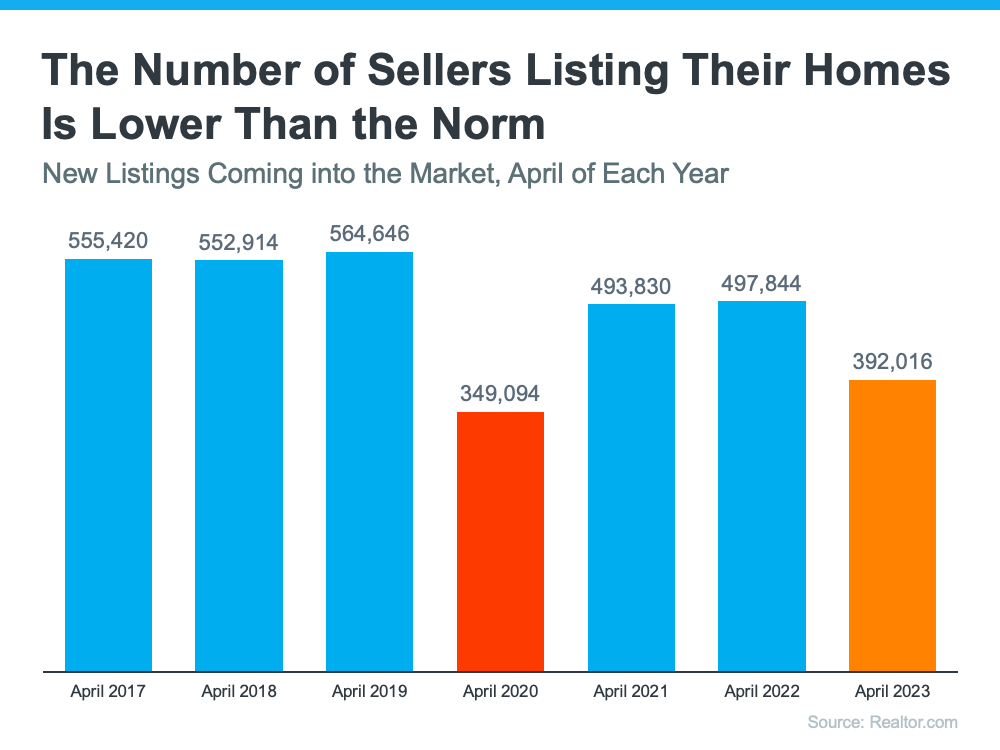
If you’re thinking about selling your house, you should know the number of homes for sale right now is low. That’s because, this season, there are fewer sellers listing their houses for sale than the norm.

Looking back at every April since 2017, the only year when fewer sellers listed their homes was in April 2020, when the pandemic hit and stalled the housing market (shown in red in the graph below). In more typical years, roughly 500,000 sellers add their homes to the market in April. This year, we saw fewer than 400,000 sellers entering the market in April (see graph below):

The Best Time To Sell Your House Is When Others Aren’t Selling | North Scottsdale Real Estate & Luxury Homes | Team Picarello

While there are a number of factors contributing to this trend, one thing keeping inventory low right now is that some homeowners are reluctant to move when the mortgage rate they have on their current house is lower than the one they could get today on their next house. It’s called rate lock.

As a recent survey from Realtor.com explains, 56% of people who are planning to sell in the next 12 months say they’re waiting for rates to come down.

While this wait-and-see approach is right for some sellers, it also creates an opening for more eager sellers to jump in now.

If your current house truly doesn’t fit your needs anymore and you’re ready to move, don’t miss this chance to stand out. When fewer sellers are putting their homes up for sale, buyers will have fewer options, so you set yourself up to get the most eyes possible on your house. That’s why your house could see multiple offers as buyers compete over the limited supply of homes for sale – especially if you price it right.

As Lawrence Yun, Chief Economist at the National Association of Realtors (NAR), says:

“Inventory levels are still at historic lows . . . Consequently, multiple offers are returning on a good number of properties.”

Bottom Line

If you’re ready to sell now, beat the competition before it comes onto the market. If you do, your house should stand out and could get multiple offers. Let’s connect to get you market ready.