

October 2022 Market Update
Note: October 2022 data below are the most recent released by the National Association of Realtors.
Total existing-home sales) completed transactions that include single-family homes, townhomes, condominiums and co-ops) decreased 5.9% from September to a seasonally adjusted annual rate of 4.43 million in October. Year-over-year, sales dropped by 28.4% (down from 6.19 million in October 2021).

"More potential homebuyers were squeezed out from qualifying for a mortgage in October as mortgage rates climbed higher," said NAR Chief Economist Lawrence Yun. "The impact is greater in expensive areas of the country and in markets that witnessed significant home price gains in recent years."
Total housing inventory at the end of October was 1.22 million units, which was down 0.8% from both September and one year ago (1.23 million). Unsold inventory sits at a 3.3-month supply at the current sales pace, up from 3.1 months in September and 2.4 months in October 2021.
"Inventory levels are still tight, which is why some homes for sale are still receiving multiple offers," Yun added. "In October, 24% of homes received over the asking price. Conversely, homes sitting on the market for more than 120 days saw prices reduced by an average of 15.8%."
The median existing-home price for all housing types in October was $379,100, a gain of 6.6% from October 2021 ($355,700), as prices rose in all regions. This marks 128 consecutive months of year-over-year increases, the longest-running streak on record.
Properties typically remained on the market for 21 days in October, up from 19 days in September and 18 days in October 2021. Sixty-four percent of homes sold in October 2022 were on the market for less than a month.
First-time buyers were responsible for 28% of sales in October, down from 29% in both September 2022 and October 2021. NAR's 2022 Profile of Home Buyers and Sellers – released earlier this month – found that the annual share of first-time buyers was 26%, the lowest since NAR began tracking the data.
All-cash sales accounted for 26% of transactions in October, up from 22% in September and 24% in October 2021.
Individual investors or second-home buyers, who make up many cash sales, purchased 16% of homes in October, up from 15% in September, but down from 17% in October 2021.
According to Freddie Mac, the average commitment rate for a 30-year, conventional, fixed-rate mortgage was 6.90% in October, up from 6.11% in September. The average commitment rate across all of 2021 was 2.96%.
"Mortgage rates have come down since peaking in mid-November, so home sales may be close to reaching the bottom in the current housing cycle," Yun said.
Regional Breakdown
Existing-home sales in the Northeast trailed off 6.6% from September to an annual rate of 570,000 in October, a decline of 23.0% from October 2021. The median price in the Northeast was $408,700, an increase of 8.0% from the previous year.
Existing-home sales in the Midwest retracted 5.3% from the previous month to an annual rate of 1,080,000 in October, falling 25.5% from the prior year. The median price in the Midwest was $274,500, up 5.9% from October 2021.
In the South, existing-home sales declined 4.8% in October from September to an annual rate of 1,980,000, a 27.2% decrease from this time last year. The median price in the South was $346,300, an increase of 8.0% from one year ago.
Existing-home sales in the West waned 9.1% from September to an annual rate of 800,000 in October, down 37.5% from one year ago. The median price in the West was $588,400, a 5.3% increase from October 2021.

Mortgage Rates Are Dropping. What Does That Mean for You?
Mortgage rates have been a hot topic in the housing market over the past 12 months. Compared to the beginning of 2022, rates have risen dramatically. Now they’re dropping, and that has to do with everything happening in the economy.
Nadia Evangelou, Senior Economist and Director of Forecasting at the National Association of Realtors (NAR), explains it well by saying:
“Mortgage rates dropped even further this week as two main factors affecting today’s mortgage market became more favorable. Inflation continued to ease while the Federal Reserve switched to a smaller interest rate hike. As a result, according to Freddie Mac, the 30-year fixed mortgage rate fell to 6.31% from 6.33% the previous week.”
So, what does that mean for your homeownership plans? As mortgage rates fluctuate, they impact your purchasing power by influencing the cost of buying a home. Even a small dip can help boost your purchasing power. Here’s how it works.
The median-priced home according to the National Association of Realtors (NAR) is $379,100. So, let’s assume you want to buy a $400,000 home. If you’re trying to shop at that price point and keep your monthly payment about $2,500-2,600 or below, here’s how your purchasing power can change as mortgage rates move up or down (see chart below). The red shows payments above that threshold and the green indicates a payment within your target range.
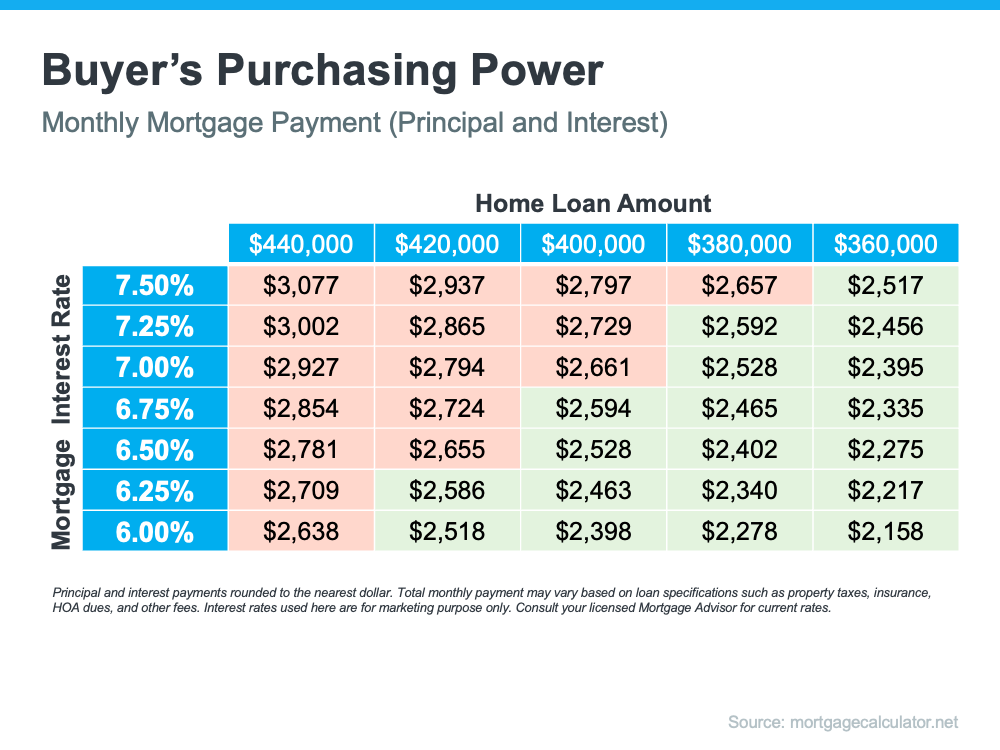
This goes to show, even a small quarter-point change in mortgage rates can impact your monthly mortgage payment. That’s why it’s important to work with a trusted real estate professional who follows what the experts are projecting for mortgage rates for the days, months, and year ahead.
Bottom Line
Mortgage rates are likely to fluctuate depending on what happens with inflation moving forward, but they have dropped slightly in recent weeks. If a 7% rate was too high for you, it may be time to contact a lender to see if the current rate is more in line with your goal for a monthly housing expense.

Homeownership Is an Investment in Your Future
There are many people thinking about buying a home, but with everything affecting the economy, some are wondering if it’s a smart decision to buy now or if it makes more sense to wait it out. As Bob Broeksmit, President and CEO of the Mortgage Bankers Association (MBA), explains:
“The desire for homeownership is strong. Many prospective buyers are waiting for the volatility in mortgage rates to subside, as well as for a clearer picture of the economic outlook.”
If you’re in that position, remember that it’s important to consider not just what’s happening today but also what benefits you may gain in the long run.
There’s a lot of information out there about how homeownership helps build a homeowner’s net worth over time. But even today, many people think first about things like 401(k)s before they think of owning a home as a wealth-building tool. It’s especially important if you’re a young prospective homebuyer to understand how homeownership is another key way to invest in your future. An article from Bloomberg notes:
“Millennials have higher average 401(k) balances than Generation X did when they were the same age, but they’re not any better off financially. . . . A lot of that has to do with being less likely to own a home.”
To help you understand just how much owning a home can have a positive impact on your life over the years, take a look at what the data shows. The same Bloomberg article helps show the gap in wealth between renters and homeowners who are 65 years and older (see graph below). The difference is substantial, even when incomes are similar.
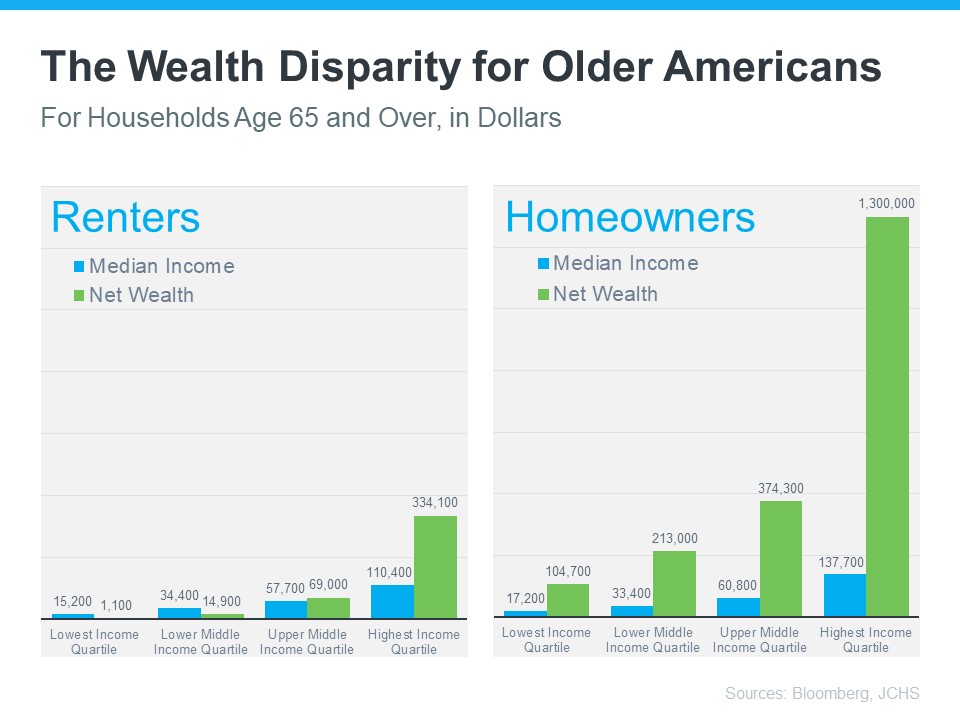
So, if you want to create wealth to help set you up for success later on, it may be time to prioritize homeownership. That’s because, whether you decide to rent or buy a home, you’ll have a monthly housing expense either way. The question is: are you going to invest in yourself and your future, or will you help someone else (your landlord) increase their wealth?
Bottom Line
Before putting your homeownership plans on hold, let’s connect to go over your options. That way, you’ll have expert advice on how to make the best decision right now and the best investment in your future.

What You Want To Know If You’re Pursuing Your Dream of Homeownership
If you’re a young adult, you may be thinking about your goals and priorities for the months and years ahead. And if homeownership ranks high on your goal sheet, you’re in good company. Many of your peers are also pursuing their dream of owning a home. The 2022 Millennial & Gen Z Borrower Sentiment Report from Maxwell says:
“Many young adults have demonstrated their resolve to embark on the journey toward homeownership soon. More than half of millennials and Gen Zs plan to apply for a mortgage sometime within the next year.”
Let’s take a look at why homeownership makes the top of so many young buyers’ to-do list and what you need to consider to achieve your goals if you’re one of them.
Top Motivators To Buy a Home
Before you start the homebuying process, it’s helpful to know why homeownership is so important to you. The survey mentioned above sheds light on some of the top reasons why younger generations are looking to buy a home. It finds:
- 95% believe the cost of renting is too high
- 35% think owing a home is an important wealth building tool
- 16% seek the sense of security owning a home provides
- 37% plan to use it as an investment property
No matter which of these resonates the most with you, know there are many financial and non-financial reasons why you may want to buy a home. While your top motivator may be different than that of your friends, they’re all equally valid and worthwhile.
Key Obstacles and How To Overcome Them
Whether your homeownership goals come from the heart or are driven by financial aspirations (or both), it can still be hard to know where to start when you’re looking to buy a home. From understanding the homebuying process, to getting pre-approved, and exploring down payment options, it’s a lot to wrap your head around.
The same Maxwell survey also reveals key challenges for potential buyers. Thankfully, the knowledge and guidance of a trusted real estate professional can help you overcome both. Here’s a look at two of the hurdles potential homebuyers say they face:
1. The Mortgage Process Can Be Intimidating
In the Maxwell study, 33.37% said one of their obstacles was that the mortgage process is confusing or difficult to understand.
An article by OwnUp helps explain why the mortgage process is so challenging for buyers:
“There is a general lack of knowledge about home financing. Mortgages are a complicated topic with no one-size-fits-all answer. It’s difficult to understand the space, let alone determine what the right course of action is based on your unique financial picture.”
While you may be tempted to do a quick search online to find instant answers to your questions, it may not get you the information you need to understand the full picture. Especially when it comes to financial advice, you want to lean on a true expert. Having trusted professionals on your side can help you to learn what it takes to achieve your dream of homeownership. Not to mention, an expert can give you advice specific to your situation, not generic advice like you’ll find online.
2. It’s Hard To Know How Much You Need To Save
In the Maxwell study, 45.75% believe they don’t have enough saved to cover their down payment or closing cost expenses.
What you may not realize is that, today, there’s a growing number of down payment assistance programs available nationwide to help relieve this pressure. A report from Down Payment Resource says:
“Our Q3 2022 HPI report revealed a 1.6% uptick in the number of homebuyer assistance programs available to help people finance homes, raising the number of programs to 2,309, a net increase of 36 over the previous quarter.”
Additionally, as the housing market cools, buyers are regaining some negotiation power and more sellers are willing to work with buyers to help with closing costs. Understanding what’s out there and the options available may help you achieve your dream of homeownership faster than you thought possible.
Bottom Line
If you’re serious about becoming a homeowner, know it may be more in reach than you think. Lean on trusted professionals to help you overcome challenges and prioritize your next steps.