

Americans See Real Estate as a Better Investment Than Stocks or Gold

Last month, in a post on the Liberty Street Economics blog, the Federal Reserve Bank of New York noted that Americans believe buying a home is definitely or probably a better investment than buying stocks. Last week, a Gallup Poll reaffirmed those findings.

In an article on the current real estate market, Gallup reports:

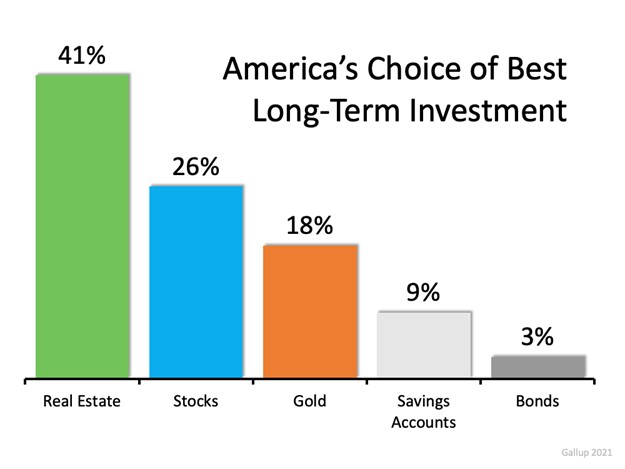
“Gallup usually finds that Americans regard real estate as the best long-term investment among several options — seeing it as superior to stocks, gold, savings accounts and bonds. This year, 41% choose real estate as the best investment, up from 35% a year ago, with stocks a distant second.”

Here’s the breakdown:The article goes on to say:
Americans See Real Estate as a Better Investment Than Stocks or Gold | North Scottsdale Real Estate & Luxury Homes | Team Picarello

“The 41% choosing real estate is the highest selecting any of the five investment options in the 11 years Gallup has asked this question.”

Is real estate really a secure investment right now?

Some question American confidence in real estate as a good long-term investment right now. They fear that the build-up in home values may be mirroring what happened right before the housing crash a little more than a decade ago. However, according to Merrill Lynch, J.P. Morgan, Morgan Stanley, and Goldman Sachs, the current real estate market is strong and sustainable.

As Morgan Stanley explains to their clients in a recent Thoughts on the Market podcast:

“Unlike 15 years ago, the euphoria in today’s home prices comes down to the simple logic of supply and demand. And we at Morgan Stanley conclude that this time the sector is on a sustainably, sturdy foundation . . . . This robust demand and highly challenged supply, along with tight mortgage lending standards, may continue to bode well for home prices. Higher interest rates and post pandemic moves could likely slow the pace of appreciation, but the upward trajectory remains very much on course.”

Bottom Line

America’s belief in the long-term investment value of homeownership has been, is, and will always be, very strong.

 

Are Interest Rates Expected to Rise Over the Next Year?

So far this year, mortgage rates continue to hover around 3%, encouraging many hopeful homebuyers to enter the housing market. However, there’s a good chance rates will increase later this year and going into 2022, ultimately making it more expensive to borrow money for a home loan. Here’s a look at what several experts have to say.

Danielle Hale, Chief Economist, realtor.com:

“Our long-term view for mortgage rates in 2021 is higher. As the economic outlook strengthens, thanks to progress against coronavirus and vaccines plus a dose of stimulus from the government, this pushes up expectations for economic growth . . . .”

Lawrence Yun, Chief Economist, National Association of Realtors (NAR):

“In 2021, I think rates will be similar or modestly higher . . . mortgage rates will continue to be historically favorable.”

Freddie Mac:

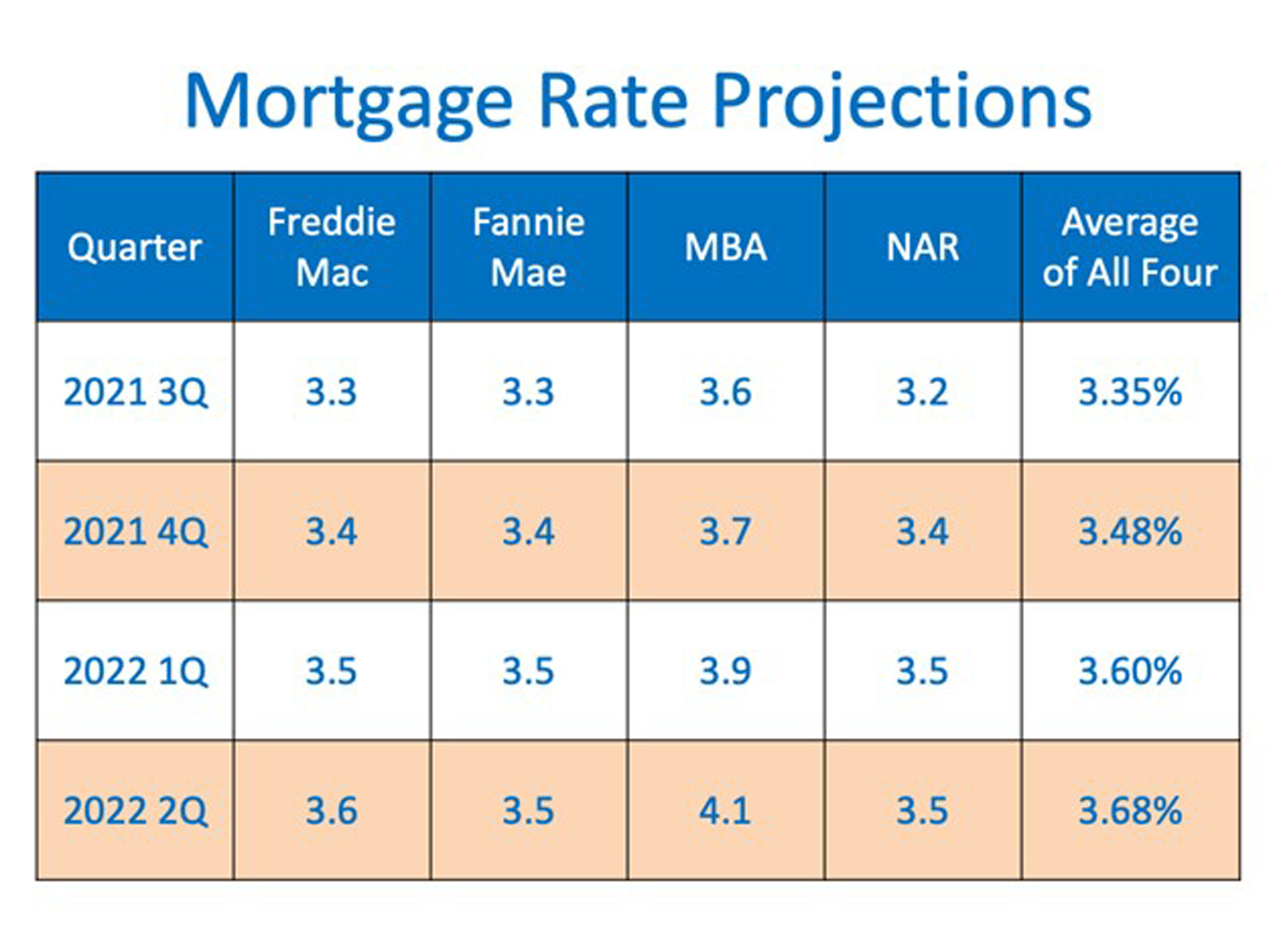
“We forecast that mortgage rates will continue to rise through the end of next year. We estimate the 30-year fixed mortgage rate will average 3.4% in the fourth quarter of 2021, rising to 3.8% in the fourth quarter of 2022.”

Below are the most recent mortgage rate forecasts from four top authorities – Freddie Mac, Fannie Mae, the Mortgage Bankers Association (MBA), and NAR:

Are Interest Rates Expected to Rise Over the Next Year? | North Scottsdale Real Estate & Luxury Homes | Team Picarello


Bottom Line

If you’re planning to buy a home, purchasing before mortgage interest rates rise may help you save significantly over the life of your home loan.

March 2021 Market Update

Note: March 2021 data below are the most recent released by the National Association of Realtors.

Existing-home sales fell in March, marking two consecutive months of declines, according to the National Association of Realtors®. The month of March saw record-high home prices and gains. While each of the four major U.S. regions experienced month-over-month drops, all four areas welcomed year-over-year gains in home sales.

Total existing-home sales (transactions that include single-family homes, townhomes, condominiums and co-ops) decreased 3.7% from February to a seasonally-adjusted annual rate of 6.01 million in March. Sales overall climbed year-over-year, up 12.3% from a year ago (5.35 million in March 2020).

National Association of Realtors March 2021 Data

“Consumers are facing much higher home prices, rising mortgage rates, and falling affordability, however, buyers are still actively in the market,” said Lawrence Yun, NAR’s chief economist.
“The sales for March would have been measurably higher, had there been more inventory,” he added. “Days-on-market are swift, multiple offers are prevalent, and buyer confidence is rising.”
Yun said although mortgage rates have risen a tick, they are still at a favorable level and the economic outlook is promising.
“At least half of the adult population has received a COVID-19 vaccination, according to reports, and recent housing starts and job creation data show encouraging dynamics of more supply and strong demand in the housing sector.”

The median existing-home price for all housing types in February was $329,100, up 17.2% from March 2020 ($280,700), as prices increased in every region. March’s national price jump marks 109 straight months of year-over-year gains.

Realtor.com®’s Market Hotness Index, measuring time-on-the-market data and listing views per property, revealed that the hottest metro areas in March were Manchester, N.H.; Concord, N.H.; Vallejo, Calif.; Burlington, N.C.; and Springfield, Ohio.

Total housing inventory at the end of March amounted to 1.07 million units, up 3.9% from February’s inventory and down 28.2% from one year ago (1.49 million). Unsold inventory sits at a 2.1-month supply at the current sales pace, marginally up from February’s 2.0-month supply and down from the 3.3-month supply recorded in March 2020. Inventory numbers continue to represent near-historic lows; NAR first began tracking the single-family home supply in 1982.

“Without an increase in supply, the society wealth division will widen with homeowners enjoying sizable equity gains while renters will struggle to become homeowners,” Yun said.

Properties typically remained on the market for 18 days in March, down from 20 days in February and from 29 days in March 2020. Eighty-three percent of the homes sold in March 2021 were on the market for less than a month.

First-time buyers were responsible for 32% of sales in March, up from 31% in February and down from 34% in March 2020. NAR’s 2020 Profile of Home Buyers and Sellers revealed that the annual share of first-time buyers was 31%.

Individual investors or second-home buyers, who account for many cash sales, purchased 15% of homes in March, down from 17% in February and up from 13% in March 2020. All-cash sales accounted for 23% of transactions in March, up from both 22% in February and from 19% in March 2020.

“NAR has made it a priority to be at the forefront of the anticipated economic revival,” said NAR President Charlie Oppler, a Realtor® from Franklin Lakes, N.J., and the CEO of Prominent Properties Sotheby’s International Realty. “We will continue pushing for an increase in housing construction and inventory, with the goal of helping qualified buyers and countless families achieve the American Dream of homeownership.”
According to Freddie Mac, the average commitment rate for a 30-year, conventional, fixed-rate mortgage was 3.08% in March, up from 2.81% in February. The average commitment rate across all of 2020 was 3.11%.