

How Smart Is It To Buy A Home Today?

How Smart Is It To Buy A Home Today?

As reported by Anthony Penna- Vice President of Sales/Marketing  Lawyer’s Title of Arizona

Whether you’re buying your first home or selling your current house, if your needs are changing and you think you need to move, the decision can be complicated. You may have to take personal or professional considerations into account, and only you can judge what impact those factors should have on your desire to move.

However, there’s one category that provides a simple answer. When deciding to buy now or wait until next year, the financial aspect of the purchase is easy to evaluate. You just need to ask yourself two questions:

Do I think home values will be higher a year from now?
Do I think mortgage rates will be higher a year from now?
From a purely financial standpoint, if the answer is ‘yes’ to either question, you should strongly consider buying now. If the answer to both questions is ‘yes,’ you should definitely buy now.

Nobody can guarantee what home values or mortgage rates will be by the end of this year. The experts, however, seem certain the answer to both questions above is a resounding ‘yes.’ Mortgage rates are expected to rise and home values are expected to appreciate rather nicely.

What does this mean to you?

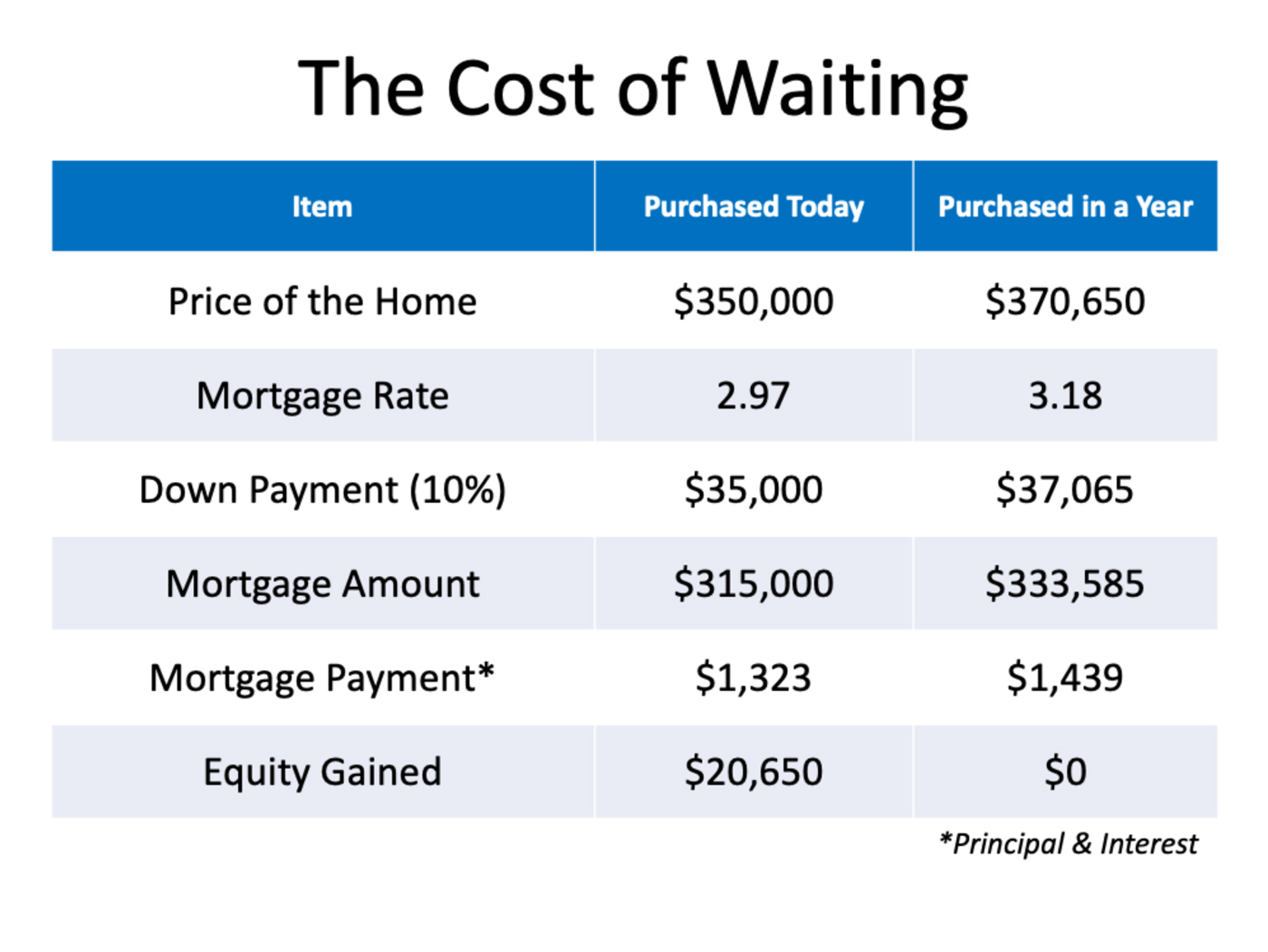
Let’s look at how waiting would impact your financial situation. Here are the assumptions made for this example:

The experts are right – mortgage rates will be 3.18% at the end of the year
The experts are right – home values will appreciate by 5.9%
You want to buy a home valued at $350,000 today
You decide on a 10% down payment
How Smart Is It To Buy A Home Today? | North Scottsdale Real Estate & Luxury Homes | Team Picarello
Here’s the financial impact of waiting:

You pay an extra $20,650 for the house
You need an additional $2,065 for a down payment
You pay an extra $116/month in your mortgage payment ($1,392 additional per year)
You don’t gain the $20,650 increase in wealth through equity build-up

Bottom Line

There are many things to consider when buying a home. However, from a purely financial aspect, if you find a home that meets your needs, buying now makes much more sense than buying next year.

January Market Report

Note: January 2021 data below are the most recent released by the National Association of Realtors.

Existing-home sales rose in January, marking two consecutive months of growth, according to the National Association of Realtors®. From a month-over-month perspective, buying activity varied in the major regions. Year-over-year, all four areas recorded double-digit gains in January.

Total existing-home sales (transactions that include single-family homes, townhomes, condominiums and co-ops) increased 0.6% from December to a seasonally-adjusted annual rate of 6.69 million in January. Sales in total climbed year-over-year, up 23.7% from a year ago (5.41 million in January 2020).

National Association of Realtors January 2021 Data

"Home sales continue to ascend in the first month of the year, as buyers quickly snatched up virtually every new listing coming on the market," said Lawrence Yun, NAR's chief economist. "Sales easily could have been even 20% higher if there had been more inventory and more choices."

The median existing-home price for all housing types in January was $303,900, up 14.1% from January 2020 ($266,300), as prices increased in every region. January's national price jump marks 107 straight months of year-over-year gains.

"Home sales are continuing to play a part in propping up the economy," Yun said. "With additional stimulus likely to pass and several vaccines now available, the housing outlook looks solid for this year."

Yun says he expects more jobs to return, which will spur homebuying in the coming months. He predicts existing-home sales will reach at least 6.5 million in 2021, even as he says mortgage rates are likely to inch higher due to the rising budget deficit and higher inflation.

Total housing inventory at the end of January amounted to 1.04 million units, down 1.9% from December and down 25.7% from one year ago (1.40 million). Unsold inventory sits at a 1.9-month supply at the current sales pace, equal to December's supply and down from the 3.1-month amount recorded in January 2020. NAR first began tracking the single-family home supply in 1982.

Properties typically remained on the market for 21 days in January, seasonally even with December and down from 43 days in January 2020. Seventy-one percent of the homes sold in January 2021 were on the market for less than a month.

First-time buyers were responsible for 33% of sales in January, up from 31% in December 2020 and from 32% in January 2020. NAR's 2020 Profile of Home Buyers and Sellers revealed that the annual share of first-time buyers was 31%.

Individual investors or second-home buyers, who account for many cash sales, purchased 15% of homes in January, up modestly from 14% in December 2020, but down from 17% in January 2020. All-cash sales accounted for 19% of transactions in January, unchanged from December but down from 21% in January 2020.

"This year, more than ever, we are prepared and eager to help families and neighbors secure housing," said NAR President Charlie Oppler, a Realtor® from Franklin Lakes, N.J., and the CEO of Prominent Properties Sotheby's International Realty. "NAR is working to close the racial homeownership gap, secure equal access to housing for all Americans and address housing affordability issues plaguing communities across the country."
 
According to Freddie Mac, the average commitment rate for a 30-year, conventional, fixed-rate mortgage was 2.74% in January, up from 2.68% in December. The average commitment rate across all of 2020 was 3.11%.